

At Scalise Family Sheep Farm in Wilton, New Hampshire, wool is part of a bigger farm story. Our Icelandic flock provides the milk we use in our handcrafted sheep-milk soap, while its fleece inspires useful wool goods for the home. We chose Icelandic sheep for their hardiness and distinctive fleeces; you can read more in From Iceland to New Hampshire: Why We Chose Icelandic Sheep.
Wool can feel warm, cushiony, and comfortable, but those qualities aren’t magic, and they don’t make every wool item right for every person or purpose. Here’s what the fiber’s structure can explain, what research says about its performance, and where it’s wise to keep expectations grounded.
What makes sheep wool different?
A wool fiber has an outer cuticle made of overlapping scale-like cells surrounding its inner structure. Researchers have studied how the arrangement of these cells varies along the fiber, and how fiber structure relates to properties such as crimp and surface feel.[1,2] The scales also contribute to wool’s tendency to felt when fibers experience moisture, heat, and friction together.
Many wool fibers have natural bends, or crimp. Crimp adds loft and helps create small pockets of still air within a textile: a useful feature in blankets, clothing, and slippers. Wool’s crimp arises from how the fiber develops, though its precise causes are complex and remain a subject of study.[3,4]
Wool is also hygroscopic: it can take up and release water vapor from the surrounding air. In controlled wear studies, wool garments absorbed more moisture vapor than polyester and helped reduce moisture in the clothing microclimate under certain conditions.[5] That is moisture buffering, not waterproofing. How comfortable a wool textile feels depends on its construction, thickness, fit, the environment, activity, and the wearer.
Wool’s performance is not a blanket promise that it will always feel warmer or drier than synthetic fabric. Comparative studies have found benefits in particular clothing and bedding setups, while also showing that outcomes depend on the materials and conditions being tested.[6,7] Wool is also relatively resistant to ignition compared with many common textile fibers, but it is not fireproof.[8]
Raw fleece contains wool grease, including lanolin. Scouring and further processing remove much of it, so finished wool items generally retain little. The amount depends on the processing. For more on how wool grease and lanolin relate to our farm’s products, read From Fleece to Jar: The Fascinating Journey of How Lanolin Is Gathered.

Wool around the home: warmth, comfort, and care
The same crimp and loft that help wool hold air can make it useful in textiles worn or used around the home. Wool slippers, hats, blankets, and other items can provide warmth and a soft, substantial feel. But “wool” covers a wide range of fibers and fabric constructions: a fine-knit garment won’t feel like a coarse woven one, and a wool blend may behave differently from a wool-only fabric.
Wool is sometimes described as hypoallergenic, but that is too broad a claim. A review of the evidence concluded that true immune reactions to wool fiber appear uncommon; many complaints described as “wool allergy” are more consistent with irritation from coarse fibers. Reactions to dyes, finishes, or other components of a garment are also possible.[9]
If a wool item feels prickly, fiber diameter and the number of coarse fiber ends protruding from the fabric may matter. Studies of fabric-evoked prickle connect wearer response to fiber and fabric characteristics, while also showing that a single measurement cannot predict everyone’s experience.[10,11] If you’re sensitive to scratchy textures, look for a smooth, fine fabric and try it against the skin before committing to extended wear. The benefits for skin of wearing any textile are individual and shouldn’t be treated as a medical result.
Care matters, too. Wool can shrink or felt with rough handling, so follow the item’s care label. We’ve put together a separate practical guide on How to Wash Wool Without Felting It. Wool is biodegradable under suitable conditions, but that doesn’t mean every finished garment will break down quickly in everyday use; dyes, finishes, construction, and disposal conditions can change the outcome.[12,13]
Wool dryer balls: a simple laundry tool, with limits
Wool dryer balls tumble among clothes, helping separate and move layers around during the drying cycle. Unlike dryer sheets, the balls themselves don’t add a sheet coating or fragrance to laundry. That may appeal to people who prefer a simpler routine, but it does not mean they replace every function of fabric softener or eliminate all laundry residues.
It’s also important to be precise about the research. A peer-reviewed 2022 study measured airborne microfiber emissions from vented tumble dryers and tested fabric conditioners and dryer sheets. It did not test wool dryer balls, so its results can’t establish that wool balls reduce microfiber emissions or outperform dryer sheets on that measure.[14] Direct head-to-head research on wool dryer balls is limited.
For practical details about using them, and a balanced look at the alternatives, see our guide to Wool Dryer Balls vs. Dryer Sheets.
Wool, fleece, and the story behind our skincare
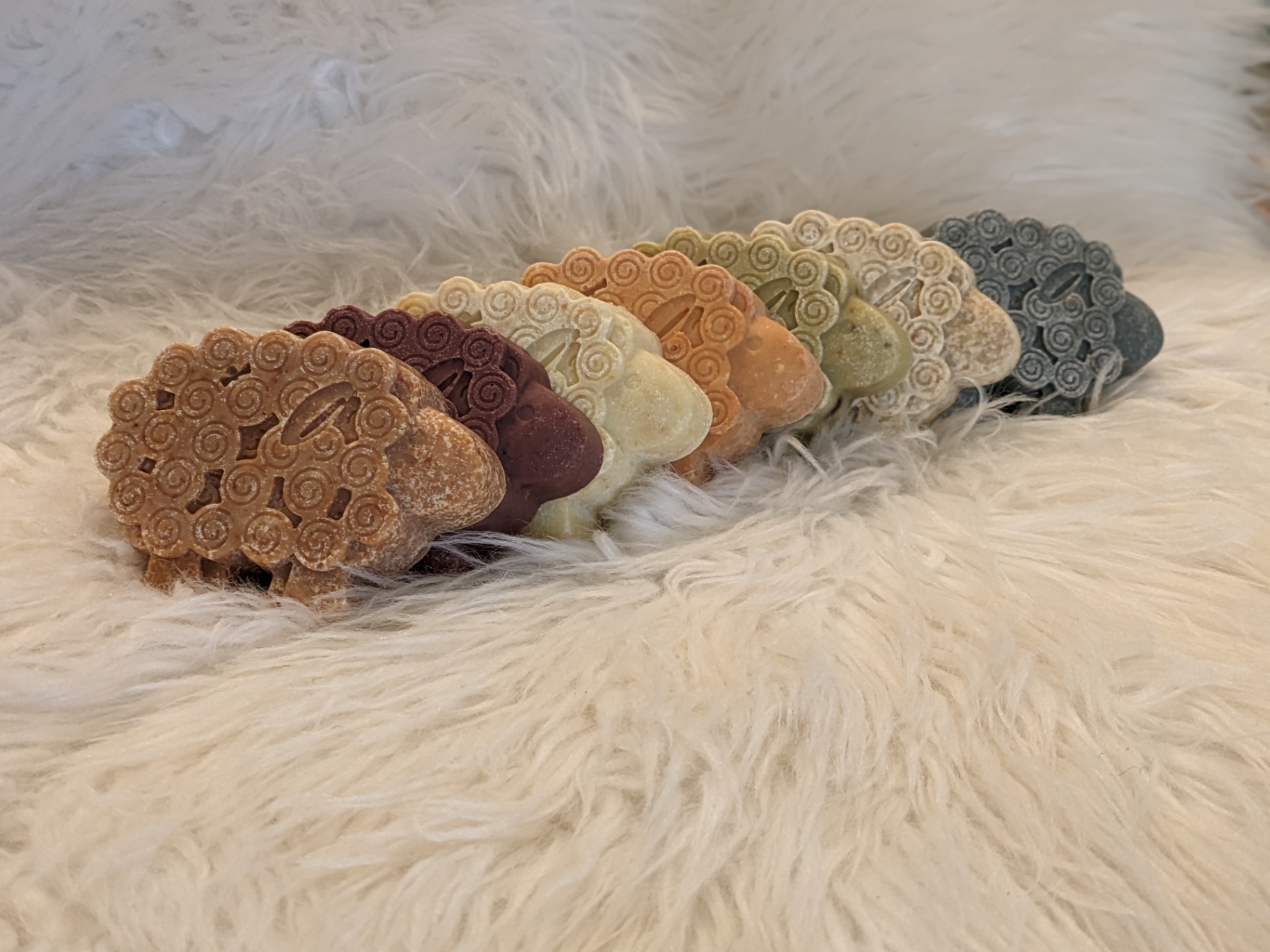
Wool fibers and sheep-milk skincare are connected by their origin on the farm, but they serve different purposes. Fleece is fiber; the milk from our Icelandic flock is an ingredient in our small-batch sheep-milk soap. Our handmade natural soap is crafted by our family, and it’s one way we turn farm production into a finished product customers can use every day.
Lanolin, recovered from wool grease, is another link between fleece and skincare. Our Unscented Skin Balm lists farm-sourced lanolin among its ingredients. As with any skincare product, ingredients can suit some people and not others; review the product details and patch-test if you’re unsure.

A note about wool dog toys
A felted wool toy is another way wool can be put to use, but it should be treated as a play item, not something to leave with every dog unsupervised. Check it regularly for damage, remove it if pieces start coming loose, and don’t offer it to an aggressive chewer. Read our wool dog-toy safety guide for more.
Explore more wool and fleece stories
Start with the post that fits your question:
- Laundry: Wool Dryer Balls vs. Dryer Sheets
- Care: How to Wash Wool Without Felting It
- Pet safety: Choosing a Wool Dog Toy and Playing Safely
- Lanolin: From Fleece to Jar
- Skincare: Unscented Skin Balm
Wool’s usefulness comes down to a combination of fiber structure, fabric construction, and thoughtful care. Its crimp and moisture-buffering behavior help explain why it’s valued in clothing and household textiles, while its varied textures mean the right choice depends on the person and the product. For our family, every wool item also tells part of the story of a farm where fleece, milk, and handcrafted goods begin with the same flock.
Academic References & Scientific Sources
- Makinson, K. R. “Bilateral Differentiation in the Cuticle of Merino Wool Fibers.” Textile Research Journal, 1978. https://doi.org/10.1177/004051757804801008
- Yu, W. et al. “Understanding the Difference in Softness of Australian Soft Rolling Skin Wool and Conventional Merino Wool.” Textile Research Journal, 2022. https://doi.org/10.1177/00405175211050524
- Munro, W. A. “Wool-Fibre Crimp Part I: The Effects of Microfibrillar Geometry.” The Journal of the Textile Institute, 1999. https://doi.org/10.1080/00405009908690618
- Hynd, P. I. et al. “Wool Fibre Crimp Is Determined by Mitotic Asymmetry and Position of Final Keratinisation and Not Ortho- and Para-Cortical Cell Segmentation.” Animal, 2009. https://doi.org/10.1017/S1751731109003966
- Li, Y., Holcombe, B. V., and Apcar, F. “Moisture Buffering Behavior of Hygroscopic Fabric During Wear.” Textile Research Journal, 1992. https://doi.org/10.1177/004051759206201101
- Umbach, K. H. “Comparative Thermophysiological Tests on Blankets Made from Wool and Acrylic-Fibre–Cotton Blends.” The Journal of the Textile Institute, 1986. https://doi.org/10.1080/00405008608658411
- Kofler, P. et al. “Effects of Two Different Battings (Sheep Wool Versus Polyester Microfiber) in an Outdoor Jacket on the Heat and Moisture Management and Comfort Sensation in the Cold.” Textile Research Journal, 2016. https://doi.org/10.1177/0040517514557317
- Zhou, X. et al. “Wool: From Properties and Structure to Genetic Insights and Sheep Improvement Strategies.” Animals, 2025. https://doi.org/10.3390/ani15192790
- Zallmann, M. et al. “Debunking the Myth of Wool Allergy: Reviewing the Evidence for Immune and Non-immune Cutaneous Reactions.” Acta Dermato-Venereologica, 2017. https://doi.org/10.2340/00015555-2655
- Garnsworthy, R. K. et al. “Identification of the Physical Stimulus and the Neural Basis of Fabric-Evoked Prickle.” Journal of Neurophysiology, 1988. https://doi.org/10.1152/jn.1988.59.4.1083
- Naylor, G. R. S. et al. “Fabric-Evoked Prickle in Worsted Spun Single Jersey Fabrics Part I: The Role of Fiber End Diameter Characteristics.” Textile Research Journal, 1997. https://doi.org/10.1177/004051759706700408
- Hodgson, A., Leighs, S. J., and van Koten, C. “Compostability of Wool Textiles by Soil Burial.” Textile Research Journal, 2023. https://doi.org/10.1177/00405175231163590
- “A Review of Clothing Microbiology: The History of Clothing and the Role of Microbes in Textiles.” Biology Letters, 2021. https://doi.org/10.1098/rsbl.2020.0700
- Lant, N. J. et al. “The Impact of Fabric Conditioning Products and Lint Filter Pore Size on Airborne Microfiber Pollution Arising from Tumble Drying.” PLOS ONE, 2022. https://doi.org/10.1371/journal.pone.0265912
- McGregor, B. A. et al. “The Influence of Fiber Diameter, Fabric Attributes and Environmental Conditions on Wetness Sensations of Next-to-Skin Knitwear.” Textile Research Journal, 2014. https://doi.org/10.1177/0040517514555800
- Cheng, X.-W. et al. “Adsorption and Flame Retardant Properties of Bio-Based Phytic Acid on Wool Fabric.” Polymers, 2019. https://doi.org/10.3390/polym11040646


