

If you are trying to build a low-waste laundry routine: or reduce fragrance exposure for sensitive skin: you may be comparing wool dryer balls vs. dryer sheets.
The short answer is nuanced:
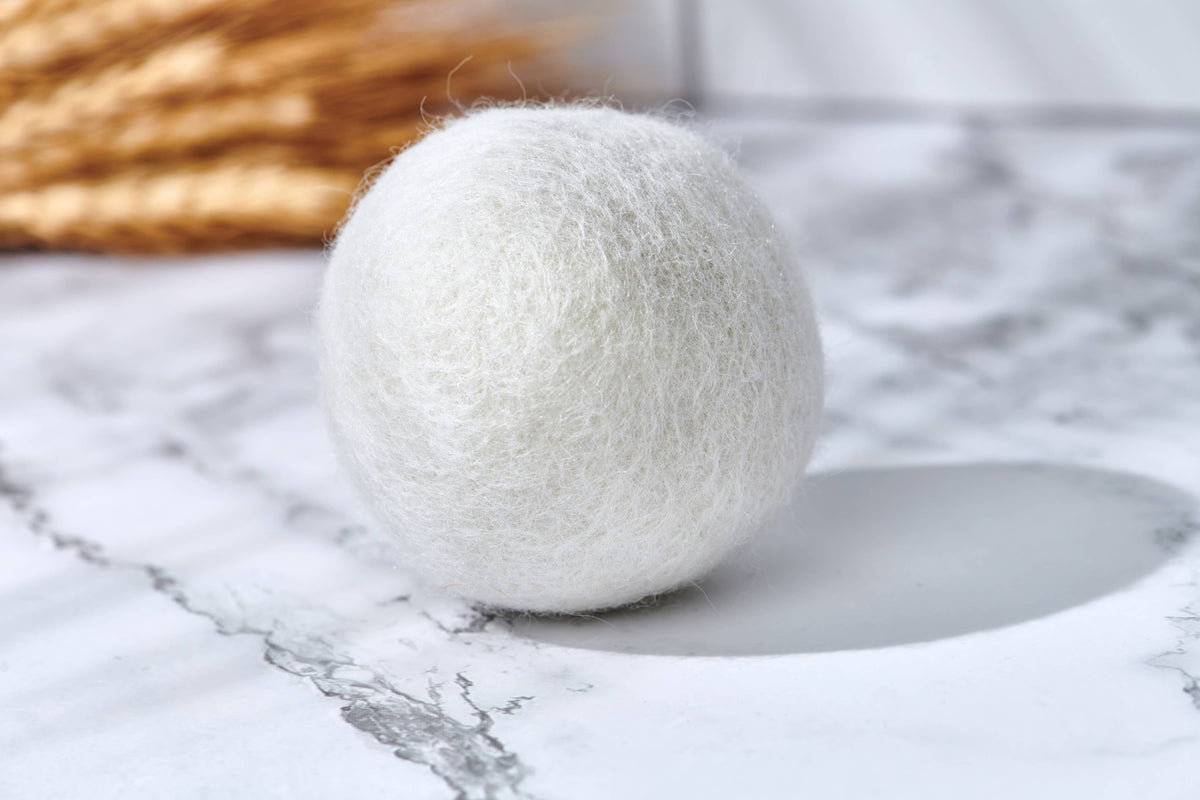
- Wool dryer balls mechanically separate and agitate clothing as the drum turns. They do not intentionally deposit fabric-conditioning chemicals or fragrance.
- Dryer sheets tumble with clothing and transfer conditioning, anti-static, and fragrance ingredients onto fabric.
- Direct, independent, peer-reviewed research comparing the two products head-to-head is limited.
- For many households, wool dryer balls are a practical way to reduce single-use waste. However, they are not guaranteed to shorten every drying cycle, eliminate static, remove allergens, or sanitize laundry.
Here is what the evidence can: and cannot: tell us.
How wool dryer balls and dryer sheets work
Wool dryer balls create physical space between garments. This may improve tumbling and airflow, especially when laundry becomes tightly packed. Their effect is mechanical rather than chemical.
Dryer sheets work through a different mechanism. Their ingredients transfer to fabric during drying, leaving a thin conditioning film that can reduce friction and static. Many products also contain fragrance compounds. Formulas vary, so it is inaccurate to treat every dryer sheet as chemically identical: or to describe all dryer sheets as inherently toxic.
The difference is important for people who prefer products that do not intentionally leave fragrance or conditioning residues on clothing.
Softness and skin comfort: dryer sheets have more direct evidence
Many people describe laundry as “softer” after using dryer sheets. Scientifically, that sensation is associated with reduced fiber-to-fiber and fabric-to-skin friction.
A randomized, double-blind study of 40 adults with dry skin found that clothing treated with fabric softener improved stratum-corneum water content in some areas compared with untreated clothing. The study did not find significant changes in every measurement, and it was small and short-term.1
A separate real-life study of 20 men with dry skin found that fabric-softener-treated underwear reduced fabric friction and improved some clinical measures of dryness. Again, the study evaluated treated fabric: not dryer balls: and it did not establish that fabric softener is appropriate for people with fragrance allergy, eczema, or contact dermatitis.2
Wool dryer balls may make clothing feel less stiff by separating and loosening garments, but they do not coat fibers with a softening film. The resulting feel may be softer and more natural rather than the especially smooth or perfumed feel associated with conventional fabric softener.
Sensitive skin and fragrance exposure
For laundry for sensitive skin, the most relevant question is often not “natural or synthetic?” but “what remains on the fabric?”
Fragrance ingredients can remain on clothing after laundering. Essential oils are also chemically active fragrances: not automatically hypoallergenic. Dermatology literature documents both irritant and allergic contact dermatitis from essential oils, including lavender, tea tree, citrus, and other oils.3
Some essential oils may also leave oily marks or discoloration on fabric, particularly when used in excessive amounts or placed directly on clothing. Peer-reviewed research on staining is limited, so this should be treated as a practical possibility rather than a universal result.
A plain wool dryer ball does not add fragrance by itself. Some people add essential oils to dryer balls, but this can undermine the fragrance-minimizing purpose and may irritate sensitive users. Essential oils can also transfer to fabric. If you use them, dilute carefully, allow the ball to dry fully, and test it first on an old cloth.
Wool is not appropriate for everyone. Anyone with a known wool or lanolin sensitivity should use caution, discontinue use if irritation occurs, and consider consulting a dermatologist.
Static and wrinkles
Dryer sheets generally have an advantage for static control because their deposited conditioning ingredients alter the surface properties of fibers. Wool dryer balls may reduce static in some loads by improving separation and airflow, but results depend on:
- Fabric type, especially synthetic fabrics
- Humidity
- Load size
- Dryness level
- Dryer temperature
- Whether laundry is overdried
Neither product reliably eliminates wrinkles. Removing clothing promptly and avoiding overloading the dryer may matter more than the accessory.
Drying time and energy use: do not trust universal percentages
Wool dryer balls are often advertised as reducing drying time by a specific percentage. The available evidence does not support a universal number for every home, dryer, or load.
Independent testing has produced mixed results. Some small trials report shorter cycles, while other consumer testing has found little difference or even slightly longer drying times. Direct peer-reviewed research specifically comparing wool dryer balls with dryer sheets remains sparse.
Dryer efficiency depends heavily on practices that have stronger support:
- Use the moisture-sensor or automatic setting when available.
- Avoid overloading the drum.
- Use a high-spin washer cycle when appropriate.
- Separate heavy towels from lightweight clothing.
- Clean the lint filter after every load.
- Air-dry clothing when practical.
ENERGY STAR identifies moisture sensing as an important feature because it can stop the dryer when clothing reaches the selected dryness level.4 A dryer ball may help in one household and make little measurable difference in another. It should not be treated as a guaranteed energy-saving device.
Microfibers: an important but complicated tradeoff
Tumble dryers can release textile fibers through their exhaust. Research has documented airborne emissions from domestic dryers, including polyester fibers from fleece textiles.5 Another household study found that dryer design, lint-trap characteristics, vent installation, and appliance age affected emissions.6
A 2022 study examined commercial fabric conditioners and dryer sheets: not wool dryer balls: and found that tested dryer sheets reduced measured airborne microfiber emissions from the dryer exhaust by approximately 14.1% to 34.9% under the study conditions.7 The authors suggested that some fibers were collected on the sheet. This does not mean dryer sheets eliminate microfiber pollution; it means some fibers were captured in that laboratory setup. The study was also partly funded by Procter & Gamble, a fabric-care manufacturer, which is important context when interpreting the findings.
A newer participatory study of household dryers found that emitted material included substantial cellulosic fibers, not only synthetic polyester.8 Therefore, “natural fiber” does not mean “impact-free,” although wool fibers are not synthetic microplastics.
There is currently no strong peer-reviewed evidence showing that wool dryer balls reduce total microfiber emissions compared with dryer sheets.
What about quaternary ammonium compounds?
A 2025 study investigated quaternary ammonium compounds (QACs) in antimicrobial-treated textiles and laundry wastewater. It reported substantial migration from those treated textiles during washing and modeled potential aquatic risks under different wastewater-treatment conditions.9
This is relevant to the broader environmental discussion around QACs, but it should not be misrepresented as a direct study of ordinary dryer sheets. It does not prove that every dryer sheet releases the same compounds or that every exposure causes harm.
Which choice is better?
| Concern | Wool dryer balls | Dryer sheets |
|---|---|---|
| Mechanism | Mechanical separation and agitation | Deposits conditioning and fragrance ingredients |
| Fragrance exposure | None if used plain | Varies by product; commonly fragranced |
| Softness | May loosen and soften fabric mechanically | More direct conditioning effect |
| Static | Variable and load-dependent | Usually stronger anti-static performance |
| Drying time | May help some loads; evidence is inconsistent | Not designed primarily to shorten drying time |
| Single-use waste | Reusable; eventual replacement is still necessary | One sheet per load plus packaging |
| Microfiber evidence | Direct comparison unavailable | Some tested sheets reduced exhaust emissions in one study |
| Allergens and sanitizing | Does not remove allergens or sanitize | Does not replace proper washing or sanitizing |
For many households, the most conservative sensitive-skin routine is fragrance-free detergent, no added essential oils, a moisture-sensor cycle, and plain wool dryer balls. If static control and a highly conditioned feel are your priorities, a dryer sheet may perform better: but fragrance-free options should be considered if you react to scented products.
Try a simple home comparison
To see what works in your dryer, compare two otherwise identical loads:
- Use the same fabric type and similar dry weight.
- Use the same detergent, washer cycle, spin speed, dryer cycle, and heat setting.
- Run one load with dryer sheets and one with wool dryer balls.
- Record cycle time or the point when the moisture sensor stops.
- Rate softness and static from 0 to 5.
- Repeat the comparison over at least three loads.
This will not replace controlled scientific research, but it will give you useful household data without assuming that a marketing claim applies universally.
At Scalise Family Sheep Farm, our natural wool dryer balls are offered in bulk and without unnecessary packaging. They reflect our family farm’s interest in practical, reusable products made from natural materials. We encourage customers to use them realistically: as a reusable alternative to disposable dryer sheets: not as a promise of guaranteed energy savings or a substitute for proper laundering.
Academic References & Scientific Sources
-
Isoda K, et al. “Treatment of cloth with a fabric softener ameliorates skin dryness.” Journal of Dermatology. 2011;38(7):685–692. PMID 21729145. DOI: 10.1111/j.1346-8138.2010.01084.x
-
Fujimura T, et al. “Real-life use of underwear treated with fabric softeners improves skin dryness by decreasing the friction of fabrics against the skin.” International Journal of Cosmetic Science. 2011;33(6):566–571. PMID 21668833. DOI: 10.1111/j.1468-2494.2011.00672.x
-
Sasseville D. “Essential Oils, Part IV: Contact Allergy.” Dermatitis. Open-access review.
-
U.S. Environmental Protection Agency and ENERGY STAR. Clothes Dryers.
-
O’Brien S, et al. “Airborne emissions of microplastic fibres from domestic laundry dryers.” Science of the Total Environment. 2020;747:141175. PMID 32781315. DOI: 10.1016/j.scitotenv.2020.141175
-
Kapp KJ, Miller RZ. “Electric clothes dryers: An underestimated source of microfiber pollution.” PLOS ONE. 2020;15(10):e0239165. PMID 33027292. DOI: 10.1371/journal.pone.0239165
-
Lant NJ, et al. “The impact of fabric conditioning products and lint filter pore size on airborne microfiber pollution arising from tumble drying.” PLOS ONE. 2022;17(4):e0265912. PMID 35385503. DOI: 10.1371/journal.pone.0265912
-
Arienzo MM, et al. “A participatory science approach to quantify microfiber emissions from clothes dryers.” Environmental Toxicology and Chemistry. 2025. PMID 41021287. DOI: 10.1093/etojnl/vgaf222
-
Guo X, et al. “Quaternary Ammonium Compounds (QACs) in Textiles and Laundry Wastewater: Occurrence and Environmental Risk Assessment.” Environmental Science & Technology. PMID 41677403. DOI: 10.1021/acs.est.5c15617


