

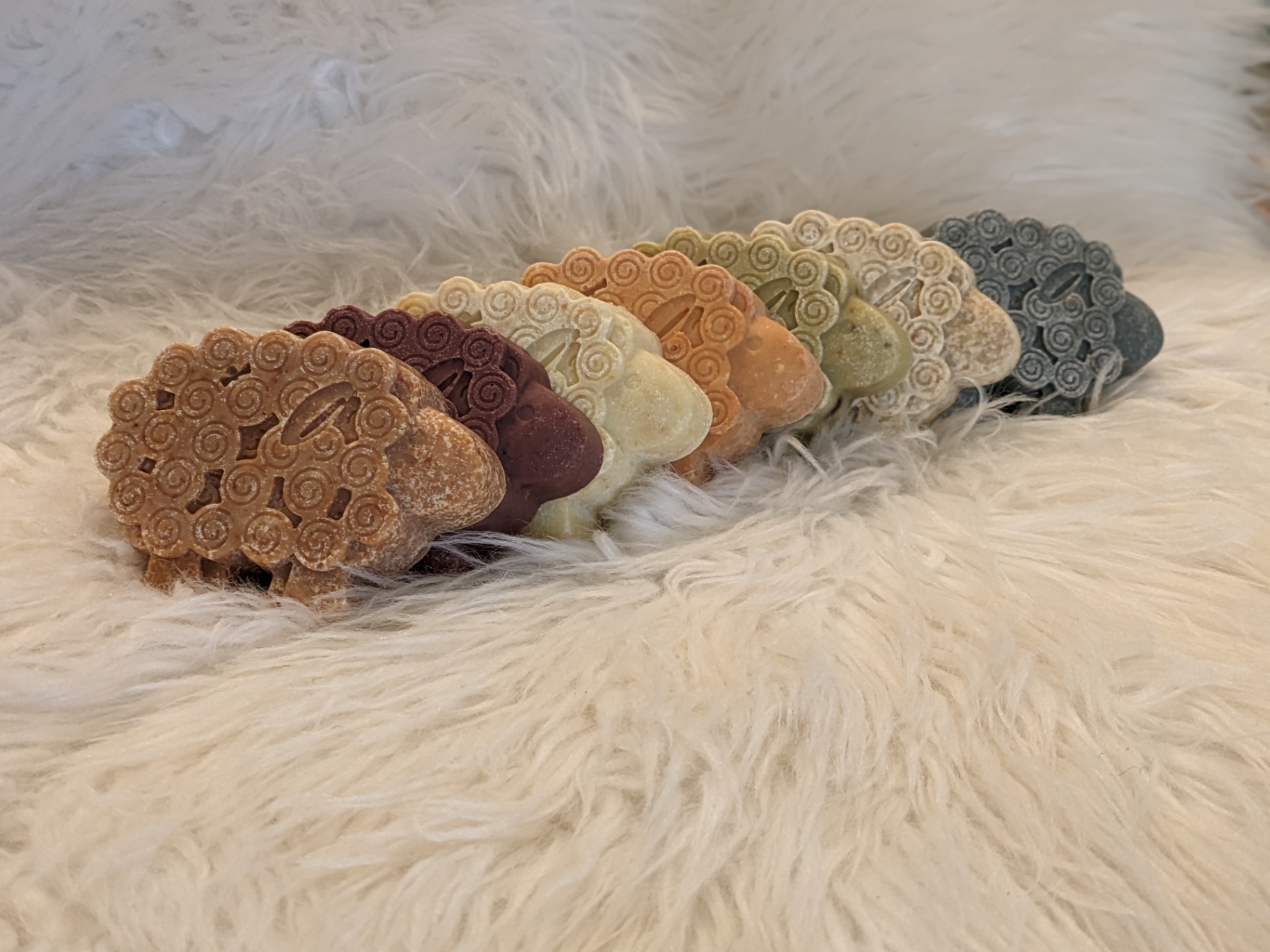
Goat milk soap is a much larger category, and it can be a genuinely good product. At Scalise Family Sheep Farm, we make sheep-milk soap from our own Icelandic flock. That means we have a perspective, but this comparison is about the ingredient science, not brand loyalty.
The most honest answer is that sheep milk and goat milk differ meaningfully as dairy ingredients, but those differences do not translate directly into proven differences in human skin outcomes. We found no published head-to-head clinical trial comparing sheep-milk soap with goat-milk soap. Claims that one is definitively superior for eczema, psoriasis, or “sensitive skin” go beyond the available evidence.
The basic composition: sheep milk is more concentrated
Compared with goat and cow milk, sheep milk generally contains more total solids, fat, and protein. A major review reports typical ranges of approximately:
| Component | Goat milk | Sheep milk |
|---|---|---|
| Total solids | 11.9–16.3% | 18.1–20.0% |
| Protein | 3.0–5.2% | 4.5–7.0% |
| Fat | 3.0–7.2% | 5.0–9.0% |
| Lactose | 3.2–5.0% | 4.1–5.9% |
Actual values vary with breed, diet, season, stage of lactation, and processing. Lactose is broadly similar across species, with considerable overlap; sheep milk is not “lactose-free” or automatically suitable for people with milk allergies.[1]
In practical soapmaking terms, the higher fat and solids in sheep milk can contribute to a richer-feeling bar. But a milk’s nutritional profile is not the same thing as a finished soap’s skin effects.
Fatty acids: what they may change in a bar
Sheep and goat milk fats contain short- and medium-chain fatty acids in different proportions from cow milk. Goat milk is often especially notable for caproic, caprylic, and capric acids. Fatty acids associated with its characteristic flavor. Sheep milk also contains these shorter-chain fats and generally has more total milk fat by volume.[1][2]
In soap, fatty-acid composition influences physical characteristics such as:
- Lather speed and volume
- Bar hardness
- Rinsability
- Creaminess and after-feel
- Oxidative stability and shelf life
Those are formulation effects, not medical benefits. Medium-chain fatty acids may help create a particular lather profile or a creamier sensory experience, but that does not make them a proven treatment for dry skin, acne, eczema, or inflammation.
Sheep milk is also frequently reported to contain more conjugated linoleic acid (CLA) than cow milk, while the difference between sheep and goat milk depends on diet, breed, season, and production system. Pasture-based feeding can substantially affect the fatty-acid profile, so “sheep versus goat” is not the only variable that matters.[2]
Protein, minerals, and vitamins: impressive milk does not equal therapeutic soap
Sheep milk has a higher total protein concentration than goat milk. The casein-to-whey ratio is also slightly different: one review summarizes sheep milk at approximately 76:24 and goat milk at approximately 78:22, compared with a more casein-dominant profile in cow milk.[1]
Sheep and goat milk also contain calcium, phosphorus, magnesium, potassium, and other minerals. Sheep milk often trends higher in mineral density, although exact values vary. A 2024 analysis of milk powders found the sheep milk powder tested had the highest calcium concentration among the three powders studied. That result is useful context, but it should not be treated as a universal value for every flock or product.[3]
Milk naturally contains fat-soluble vitamins such as A and E, along with B-group vitamins. Vitamin D content is variable and may be affected by animal diet, sunlight, fortification, and processing.
Here is the key point: the nutritional profile of drinking milk does not transfer one-to-one to soap.
During saponification, fats react with an alkali to form soap and glycerin. Proteins, sugars, vitamins, and minerals are exposed to heat, high pH, dilution, and chemical change. Some components may remain in altered or small quantities, but a bar of soap is not a nutritional delivery system. It is also rinsed away.
That is why “higher protein,” “more calcium,” or “more vitamins” should not automatically be presented as proven skincare benefits.
Lactic acid: a real dermatology ingredient, but not an AHA soap treatment
Milk contains naturally occurring lactic acid, and fermentation can increase lactic acid levels. Lactic acid is also an alpha-hydroxy acid (AHA) used in controlled dermatologic and cosmetic formulations for exfoliation, hydration, and skin-texture concerns.[4]
However, a traditional bar soap is fundamentally different from a leave-on lactic-acid product:
- Soap is rinsed off within seconds.
- True soap is typically alkaline rather than acidic.
- The amount of lactic acid contributed by milk is far below the concentration used in formulated AHA products.
- Saponification and the bar’s high pH change the chemical environment.
Therefore, sheep-milk soap or goat-milk soap should not be expected to exfoliate, remodel collagen, fade pigmentation, or smooth keratosis pilaris in the way a properly formulated leave-on lactic-acid product may. The presence of milk does not turn a cleansing bar into an AHA treatment.
Lanolin is from wool, not milk
Lanolin is a waxy, occlusive material obtained from sheep’s wool. It is used in some barrier-repair and moisturizing formulations because it can reduce water loss from the skin.
Lanolin is not naturally a component of sheep milk. A sheep-milk soap may contain no lanolin at all unless it has been deliberately added or is part of another ingredient blend. Check the ingredient list rather than assuming that “sheep” means “lanolin.”
Lanolin is also a recognized contact allergen. A contemporary review describes contact allergy in approximately 0.4% of the European general population, with higher rates among some dermatitis and chronic-wound populations.[5] People with known lanolin allergy should avoid products containing lanolin or wool alcohols.
Fragrance may matter more than the milk
Both sheep-milk and goat-milk soaps are commonly scented with essential oils, fragrance oils, or aromatic botanical extracts. For many people, fragrance, not the milk, is the more relevant source of irritation or allergic contact dermatitis.
A 2024 dermatology review notes that fragrance contact allergy is common and that prevalence depends heavily on the marker and population tested. In one European general-population study using multiple fragrance markers, the prevalence was approximately 4.5%.[6] Essential oils can also cause contact allergy. An IVDK analysis of 10,930 dermatitis patients tested with essential oils found that 8.3% reacted to at least one oil; this was a dermatitis-clinic population, not the general public.[7]
“Natural” does not mean non-allergenic. Lavender, peppermint, citrus, clove, lemongrass, ylang-ylang, and other botanicals contain compounds that can irritate or sensitize some individuals.
If your skin is reactive, an unscented sheep-milk soap or goat-milk soap is usually a more informative choice than comparing the milk species while ignoring the fragrance load.
What about milk allergy?
Milk-protein allergy is real, and topical exposure to milk-containing cosmetics has caused documented reactions. A 2022 case series reported seven patients who developed IgE-mediated reactions to goat or sheep milk after prior use of goat-milk skin products, including soaps and moisturizers.[8]
That report is important but should be interpreted carefully. It does not show that most people will become allergic from a rinse-off soap. It does show that food proteins in skincare can be clinically relevant, especially when used repeatedly on damaged or inflamed skin.
Anyone with a diagnosed cow, goat, or sheep milk allergy should discuss topical dairy ingredients with an allergist or physician rather than assuming that rinse-off exposure is risk-free.

How to compare sheep-milk soap and goat-milk soap
When choosing between sheep milk soap vs. goat milk soap, look beyond the animal pictured on the label:
- How is the milk listed? Fresh milk, milk powder, reconstituted milk, and “milk extract” are not interchangeable descriptions.
- Is the milk ingredient clearly identified? A transparent ingredient list is more useful than broad terms such as “farm blend.”
- What oils are saponified? The overall oil blend often affects hardness, lather, and after-feel more than the species of milk.
- Is it fragranced? If you have sensitive or allergy-prone skin, consider unscented first.
- Is glycerin retained? Traditional handmade soap naturally produces glycerin during saponification; some commercial processes remove it.
- What is the bar’s pH? True soap is alkaline. A “pH-balanced” cleanser may be a different type of product.
- Was the bar properly cured? A longer cure can improve hardness, longevity, and overall washing feel.
- Can the maker explain the process? Small-batch soapmakers should be able to answer questions about milk, oils, fragrance, cure time, and testing.
At Scalise Family Sheep Farm, we make our sheep-milk soap in small batches using milk from our own Icelandic sheep. You can explore our sheep milk soap collection, including lavender sheep milk soap and frankincense sheep milk soap.
The bottom line
Goat milk soap is a legitimate, popular handmade soap category. Sheep milk is more concentrated in fat, protein, and total solids, and those differences may influence the character of a finished bar. But there is no clinical evidence showing that sheep-milk soap is superior to goat-milk soap for human skin.
Choose based on the full formula: the oils, fragrance, milk form, cure, transparency of the maker, and your own skin’s response. That is a more evidence-based approach than relying on exaggerated “benefits for skin” claims.
Medical disclaimer: This article is for general educational purposes and is not medical advice. Sheep-milk and goat-milk soaps are not treatments for eczema, psoriasis, acne, allergies, or any other medical condition. If you have persistent irritation, broken skin, a known milk allergy, or suspected contact dermatitis, stop using the product and consult a qualified healthcare professional.
Academic References & Scientific Sources
-
Roy D, Ye A, Moughan PJ, Singh H. “Composition, Structure, and Digestive Dynamics of Milk From Different Species: A Review.” Frontiers in Nutrition. 2020;7:577759. DOI: 10.3389/fnut.2020.577759 · PMID: 33123547
-
Markiewicz-Kęszycka M, Czyżak-Runowska G, Lipińska P, Wójtowski J. “Fatty Acid Profile of Milk: A Review.” Journal of Veterinary Research. 2013;57(2):135–139. DOI: 10.2478/bvip-2013-0026
-
Yang C, Pan J, Pang S, et al. “Comparative analysis of the nutritional composition, digestibility, metabolomics profiles and growth influence of cow, goat and sheep milk powder diets in rat models.” Frontiers in Nutrition. 2024;11:1428938. DOI: 10.3389/fnut.2024.1428938 · PMID: 39650706
-
Babilas P, Knie U, Abels C. “Cosmetic and dermatologic use of alpha hydroxy acids.” Journal der Deutschen Dermatologischen Gesellschaft. 2012;10(7):488–491. DOI: 10.1111/j.1610-0387.2012.07939.x · PMID: 22916351
-
Jenkins BA, Belsito DV. “Lanolin.” Dermatitis. 2023;34(1):4–12. DOI: 10.1089/derm.2022.0002 · PMID: 36917502
-
Sukakul T, Bruze M, Svedman C. “Fragrance Contact Allergy: A Review Focusing on Patch Testing.” Acta Dermato-Venereologica. 2024;104:40332. DOI: 10.2340/actadv.v104.40332 · PMID: 39140486
-
Geier J, Schubert S, Reich K, et al. “Contact sensitization to essential oils: IVDK data of the years 2010–2019.” Contact Dermatitis. 2022;87(1):71–80. DOI: 10.1111/cod.14126 · PMID: 35395160
-
“Goat milk skin products may cause the development of goat milk allergy.” Clinical & Experimental Allergy. 2022;52(5):706–710. DOI: 10.1111/cea.14133 · PMID: 35384104


