

A cooling rub, a warming balm, a patch that stings: topical pain products can feel convincing. But does that sensation mean they work, and for what kind of discomfort?
The short answer is that some topical ingredients can change pain perception, but the evidence depends on the ingredient, concentration, formulation and type of pain. A sensory effect is not proof that an injury is healing, and results from a prescription-strength treatment should not be assumed to apply to every balm or cream.
Different ingredients, different sensory pathways
Many products are described as counterirritants: they create a noticeable skin sensation that may compete with or alter the experience of discomfort. Several also act on transient receptor potential (TRP) channels. Sensory proteins involved in detecting temperature and chemical stimuli. But these ingredients do not all work in the same way.[1,5]
- Menthol activates TRPM8, a channel associated with cooling. That helps explain why menthol can feel cold even when the skin is not getting colder. At higher exposures, menthol can also reduce responses in capsaicin-sensitive pathways, including TRPV1, in experimental settings. The effect depends on concentration and context; more is not automatically better.[1–4]
- Capsaicin activates TRPV1, which can produce burning or warmth. With sufficient repeated exposure, it can temporarily reduce the responsiveness of pain-sensing nerve endings. A process often called defunctionalization. Changes in substance P, a neuropeptide involved in pain signaling, may occur, but substance P depletion alone is not a complete explanation for capsaicin’s effects.[20,21]
- Camphor can activate and then strongly desensitize TRPV1 in laboratory studies, through a mechanism distinct from capsaicin’s. It also affects other sensory channels. These findings offer a possible mechanism, not proof of strong clinical benefit.[3,5]
- Methyl salicylate is commonly grouped with counterirritants and rubefacients. Ingredients that can produce a local warming or irritating sensation. Its pharmacology is not interchangeable with menthol’s TRPM8 action or capsaicin’s TRPV1 action, and its precise contribution in combination products can be difficult to separate.[5,12]
What does the clinical evidence support?
Capsaicin: strongest evidence for certain nerve pain, not general muscle soreness. Cochrane reviews find the best evidence for prescription-strength 8% capsaicin patches in some adults with chronic peripheral neuropathic pain, particularly postherpetic neuralgia. Even there, a meaningful reduction in pain occurs for a portion, not everyone. Evidence is weaker for some other neuropathic conditions.[6,8,9]
That finding should not be stretched into a claim that capsaicin is proven for everyday muscle soreness. Low-concentration creams, commonly used repeatedly, have a separate and less certain evidence base. A Cochrane review concluded that the available trials were too limited and inconsistent to establish reliable benefit beyond placebo.[7] Capsaicin may also cause considerable burning and stinging.
Menthol: promising sensory effects, but limited evidence for sore muscles. A small randomized study in 16 healthy volunteers found that applying a menthol analgesic increased pressure-pain thresholds shortly afterward. That is an experimental measure of sensitivity, not evidence that menthol treats an injury or provides lasting relief.[11]
A larger placebo-controlled trial studied a specific patch containing 10% methyl salicylate and 3% menthol in 208 adults with mild-to-moderate muscle strain. It found greater short-term relief of pain with movement than with a placebo patch. This supports that particular combination and use case; it does not show how much relief came from menthol alone.[10] Reviews of topical analgesics also note that formulations and study quality vary.[1,5]
Camphor: plausible mechanism, less persuasive clinical evidence. Laboratory findings about TRPV1 are interesting, but channel activity in a dish does not demonstrate reliable relief in people. Clinical evidence for camphor-containing products is limited, and many products combine it with other ingredients, making individual effects hard to identify.[3,5]

Gate control: a useful idea, not the whole story
Gate control theory proposes that activity from one kind of sensory input can influence how pain signals are processed in the nervous system. It helps explain why rubbing an area, or feeling cooling or warmth on the skin, may change the way discomfort is experienced.[13]
But it is a long-standing, incomplete model, not a settled explanation for every topical ingredient. TRP-channel activity, nerve sensitivity, attention and expectation may all contribute. If a product’s benefit partly comes from a competing sensation, that does not make the experience imaginary or useless. It means the intervention may modulate perceived discomfort rather than repair the underlying cause. Because it is difficult to mask a noticeable warming or cooling sensation in a trial, expectation and placebo effects can also complicate results.[14]
Safety: topical does not mean risk-free
Use products according to their label. Methyl salicylate can be absorbed through the skin, and serious systemic salicylate toxicity has been reported after excessive or prolonged topical exposure. Applying it over large areas, to damaged skin, under an occlusive dressing or alongside heat can raise concern. Do not combine multiple salicylate products without checking with a clinician or pharmacist, especially if you take aspirin or blood-thinning medication, have kidney disease, or are pregnant or breastfeeding.[15,16]
Capsaicin can cause intense burning and irritation. Keep it away from eyes, mucous membranes and sensitive areas, and wash hands carefully after use.
Camphor can be dangerous to children if swallowed or misused. Do not use camphor-containing products on children unless a clinician specifically directs you to. Store them securely out of reach. Suspected ingestion or significant exposure warrants prompt advice from Poison Control or emergency services.[17–19]
Seek medical advice for severe or persistent pain, pain after a significant injury, new weakness or numbness, or symptoms that are worsening. A topical product should not delay assessment of a possible medical problem.
Where a small-farm salve fits
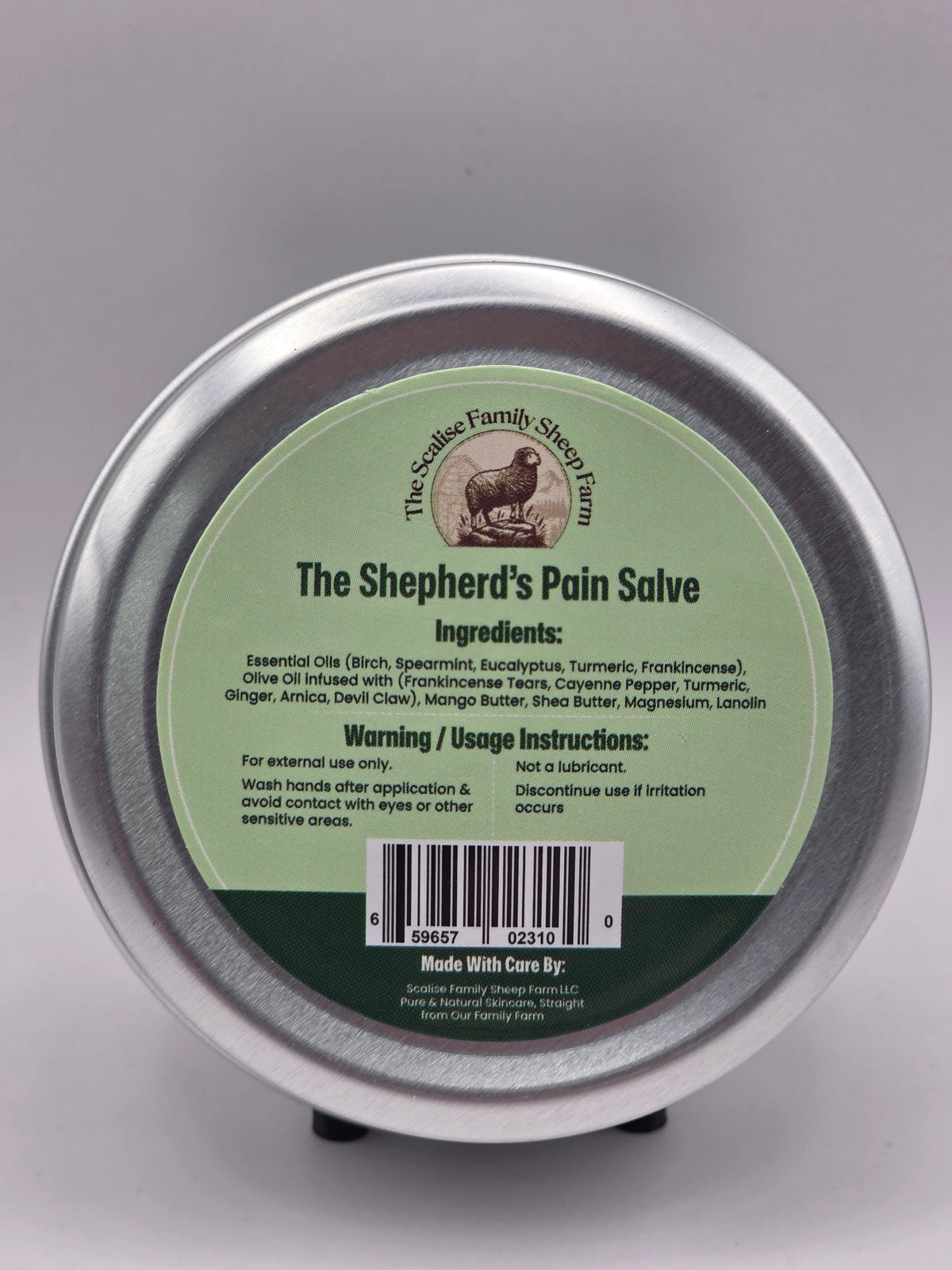
The Shepherd’s Pain Salve is a small-batch, handmade product from our family farm. Its label lists a blend that includes botanical oils and extracts, cayenne, spearmint and eucalyptus, along with moisturizing ingredients such as mango butter, shea butter and lanolin. The label does not provide verified concentrations of capsaicin, menthol or other active drug ingredients, so it would not be responsible to equate the product with the doses used in clinical trials.
We present it as a cosmetic massage balm, not an FDA-approved drug or a treatment for arthritis, neuropathy or another diagnosed condition. Someone who enjoys applying a warming, aromatic salve after a long day may value the sensory experience and the moisturizing benefits for skin. That is different from claiming that the product treats pain or changes an underlying condition.
And while a handmade natural soap and a balm may both be part of a thoughtful skincare routine, they serve different purposes: soap is rinsed off, while a balm stays on the skin. Neither should be confused with a medicine.
Bottom line: Some topical ingredients can alter sensation, and certain formulations have evidence for specific kinds of pain. Capsaicin’s strongest support is for selected neuropathic pain, not routine muscle soreness. Menthol and methyl-salicylate combinations have some short-term evidence for muscle strain, while camphor’s clinical support is less established. Read labels, take safety seriously, and treat a noticeable sensation as a sensation, not proof of treatment.
This article is for general information only, not medical advice. The Shepherd’s Pain Salve is a cosmetic/topical product, not an FDA-approved drug. No statements here are intended as a medical treatment claim.
Academic References
- Pergolizzi JV Jr, et al. “The role and mechanism of action of menthol in topical analgesic products.” Journal of Clinical Pharmacy and Therapeutics. 2018;43(3):313–319. PubMed
- McKemy DD, Neuhausser WM, Julius D. “Identification of a cold receptor reveals a general role for TRP channels in thermosensation.” Nature. 2002;416:52–58. DOI
- Xu H, Blair NT, Clapham DE. “Camphor activates and strongly desensitizes the transient receptor potential vanilloid subtype 1 channel in a vanilloid-independent mechanism.” Journal of Neuroscience. 2005;25(39):8924–8937. PubMed
- “Reciprocal effects of capsaicin and menthol on thermosensation through regulated activities of TRPV1 and TRPM8.” PubMed
- Barkin RL. “The pharmacology of topical analgesics.” Postgraduate Medicine. 2013;125(4 Suppl 1):7–18. PubMed
- Derry S, et al. “Topical capsaicin (high concentration) for chronic neuropathic pain in adults.” Cochrane Database of Systematic Reviews. 2017;1:CD007393. Cochrane
- Derry S, Moore RA. “Topical capsaicin (low concentration) for chronic neuropathic pain in adults.” Cochrane Database of Systematic Reviews. 2012;9:CD010111. Cochrane
- Derry S, Lloyd R, Moore RA, McQuay HJ. “Topical capsaicin for chronic neuropathic pain in adults.” Cochrane Database of Systematic Reviews. 2009. PubMed
- Zajączkowska R, et al. “Topical Treatments and Their Molecular/Cellular Mechanisms in Patients with Peripheral Neuropathic Pain: Narrative Review.” Pharmaceutics. 2021;13(4):450. PubMed
- Higashi Y, Kiuchi T, Furuta K. “Efficacy and safety profile of a topical methyl salicylate and menthol patch in adult patients with mild to moderate muscle strain.” Clinical Therapeutics. 2010;32(1):34–43. PubMed
- Behm DG, et al. “Menthol-Based Topical Analgesic Induces Similar Upper and Lower Body Pain Pressure Threshold Values: A Randomized Trial.” Journal of Sport Rehabilitation. 2022;31(1):24–30. PubMed
- Mason L, et al. “Systematic review of efficacy of topical rubefacients containing salicylates for the treatment of acute and chronic pain.” BMJ. 2004;328:995. DOI
- Melzack R, Wall PD. “Pain mechanisms: a new theory.” Science. 1965;150(3699):971–979. DOI
- Wager TD, Atlas LY. “The neuroscience of placebo effects: connecting context, learning and health.” Nature Reviews Neuroscience. 2015;16:403–418. DOI
- “Risk of toxicity from pediatric topical salicylate ingestions.” Clinical Toxicology. DOI
- “Salicylate Toxicity from Ingestion and Continued Dermal Absorption.” PubMed Central
- “Are one or two dangerous? Camphor exposure in toddlers.” PubMed
- “Unintentional exposure of young children to camphor and eucalyptus oils.” PubMed Central
- Manoguerra AS, et al. “Camphor poisoning: an evidence-based practice guideline for out-of-hospital management.” Clinical Toxicology. 2006. DOI
- Anand P, Bley K. “Topical capsaicin for pain management: therapeutic potential and mechanisms of action.” British Journal of Anaesthesia. 2011;107(4):490–502. PubMed
- Caterina MJ, et al. “The capsaicin receptor: a heat-activated ion channel in the pain pathway.” Nature. 1997;389:816–824. PubMed
- “High-Concentration L-Menthol Exhibits Counter-Irritancy to Neurogenic Inflammation, Thermal and Mechanical Hyperalgesia Caused by Trans-cinnamaldehyde.” Journal of Pain. DOI
- Liu B, et al. “TRPM8 is the principal mediator of menthol-induced analgesia of acute and inflammatory pain.” PubMed
- Derry S, et al. “Systematic review of topical capsaicin for the treatment of chronic pain.” BMJ. 2004. DOI


