

A good beard routine is usually straightforward: cleanse without overdoing it, trim in a way that suits your hair and skin, and choose styling products for the job you want them to do. Beard balm and pomade can help with grooming, but they are not treatments for skin conditions, and the best product is not necessarily the one with the longest ingredient list.
Here’s what dermatology and cosmetic science can tell us about beard hair, common grooming problems, and how to choose products thoughtfully.
Beard hair is not just scalp hair, moved south
Beard fibers tend to be thicker and more irregular in shape than scalp fibers, although hair varies considerably between people and even across one person’s face. A comparative study found structural differences between beard and scalp hair, while later reviews discuss how fiber thickness, direction, and density can make shaving less predictable. Tolgyesi et al.’s comparative study; Maurer et al..
Facial hair is also influenced by androgens and grows in cycles. Hair follicles do not all move through those cycles together, and the growth phase of facial hair differs from that of scalp hair. In practice, that means beard length, density, and texture can vary across the cheeks, chin, and neck. Ebling’s review of hair biology; Boothby-Shoemaker et al.’s dermatologist’s guide to beards.
The skin beneath a beard has its own set of concerns. Shaving can cause irritation; curved or closely cut hairs can grow back into the skin and trigger pseudofolliculitis barbae (PFB); and flaking or redness may be related to seborrheic dermatitis, contact dermatitis, or another condition. These problems can look alike, so persistent symptoms are worth discussing with a dermatologist. Gray and McMichael’s PFB review; Maurer et al..

Beard balm and pomade: what they do
Beard balm is generally a leave-on styling product built from a blend of waxes, butters, and oils. In broad terms, the wax helps give the product structure and some shaping ability; oils and butters contribute slip and a conditioning feel. The exact balance varies, so products sold as “balm” can have very different textures and levels of hold.
Pomade is a hair-styling product. Depending on its formula, it may be designed for hold, shine, or a particular finish. Waxes and other structuring ingredients affect its body and hold; oils and emollients influence how it spreads and feels. These are formulation roles, not proof that a product improves skin or hair health. There is no established clinical formula that makes one beard balm or pomade best for everyone.
Our Shepherd’s Pomade is listed as a small-batch hair styling pomade with rosemary, horsetail, and juniper essential oils. It is marketed for hair, so we do not present it as a beard balm or claim that it treats the skin beneath facial hair. Essential oils can be sources of fragrance exposure, too; “natural” does not automatically mean irritation-free.
Product choice matters when skin is freshly shaved
Beard and hair-care products can be sources of contact dermatitis. In one large North American Contact Dermatitis Group analysis of men referred for patch testing with facial dermatitis, personal-care products were a frequent source of relevant allergens. A separate analysis of hair-care-product reactions identified allergens including para-phenylenediamine (PPD), a chemical used in some hair dyes. These are patch-tested patient groups, not estimates of how often every man will react, but they show why product ingredients and exposure history matter. Male facial dermatitis analysis; hair-care product analysis.
PPD can also cause allergic dermatitis when used in beard dye. If you color facial hair, follow product directions and warnings carefully; stop using the dye and seek medical advice if a reaction develops. Hsu et al..
Fragrance deserves special attention after shaving. A small observational study found an association between blade shaving and fragrance allergy among men already diagnosed with fragrance allergy. The authors suggested that shaving-related micro-injury could increase exposure to fragrance ingredients, but the study does not prove that shaving caused the allergy. Edman. A population study in five European countries found that fragrance-allergy estimates varied according to testing and the definition used. Diepgen et al..
A practical takeaway: if your face is freshly shaved or easily irritated, consider a fragrance-free product, particularly on the shaved area. Patch-test new products cautiously and stop using anything that causes burning, itching, or a rash. “Unscented,” “natural,” and “clean” are not guarantees that a product cannot cause a reaction.

A practical, evidence-aligned beard routine
- Cleanse gently. Use warm, not hot, water and a gentle cleanser. Avoid harsh household cleaners or scrubbing the beard area until it feels squeaky clean. A handmade sheep-milk soap may suit your routine if your skin tolerates it; no one cleanser works for everyone.
- Avoid over-washing. Cleanse as needed to remove sweat, dirt, and product buildup. If the skin becomes tight, dry, or irritated, reduce washing or try a different cleanser.
- Use balm sparingly. If you use beard balm, try a small amount on a slightly damp beard and work it through the hair. This can help with styling and flyaways; it is not a treatment for a skin condition.
- Trim for your skin and style. Very close shaving can be difficult for some hair types and skin. If you get ingrown hairs, consider leaving a little length and avoid repeatedly pressing or scraping over the same area. Advice for PFB is not one-size-fits-all, and research on grooming methods is limited. Gray and McMichael; Sukakul et al..
- Keep exfoliation gentle. Avoid aggressive scrubs, especially over bumps or freshly shaved skin. Stop if exfoliation makes irritation worse.
See a dermatologist for persistent or painful bumps, recurring flaking or redness, suspected infection, or patches of beard hair loss. Symptoms that resemble ordinary shaving irritation can have other causes and may need a specific diagnosis.
Farm-made grooming, honestly
Scalise Family Sheep Farm is a family-owned, veteran-operated farm in Wilton, New Hampshire. We make products in small batches and prioritize natural ingredients, with no artificial colors or additives. Our Pomade is listed at $10; our Cedar Solid Cologne is $7.50; and The Shepherd’s Body Powder is $10. The cologne and powder are grooming products, not beard treatments. Check each product’s ingredient list and directions before use, especially if you are sensitive to fragrance.
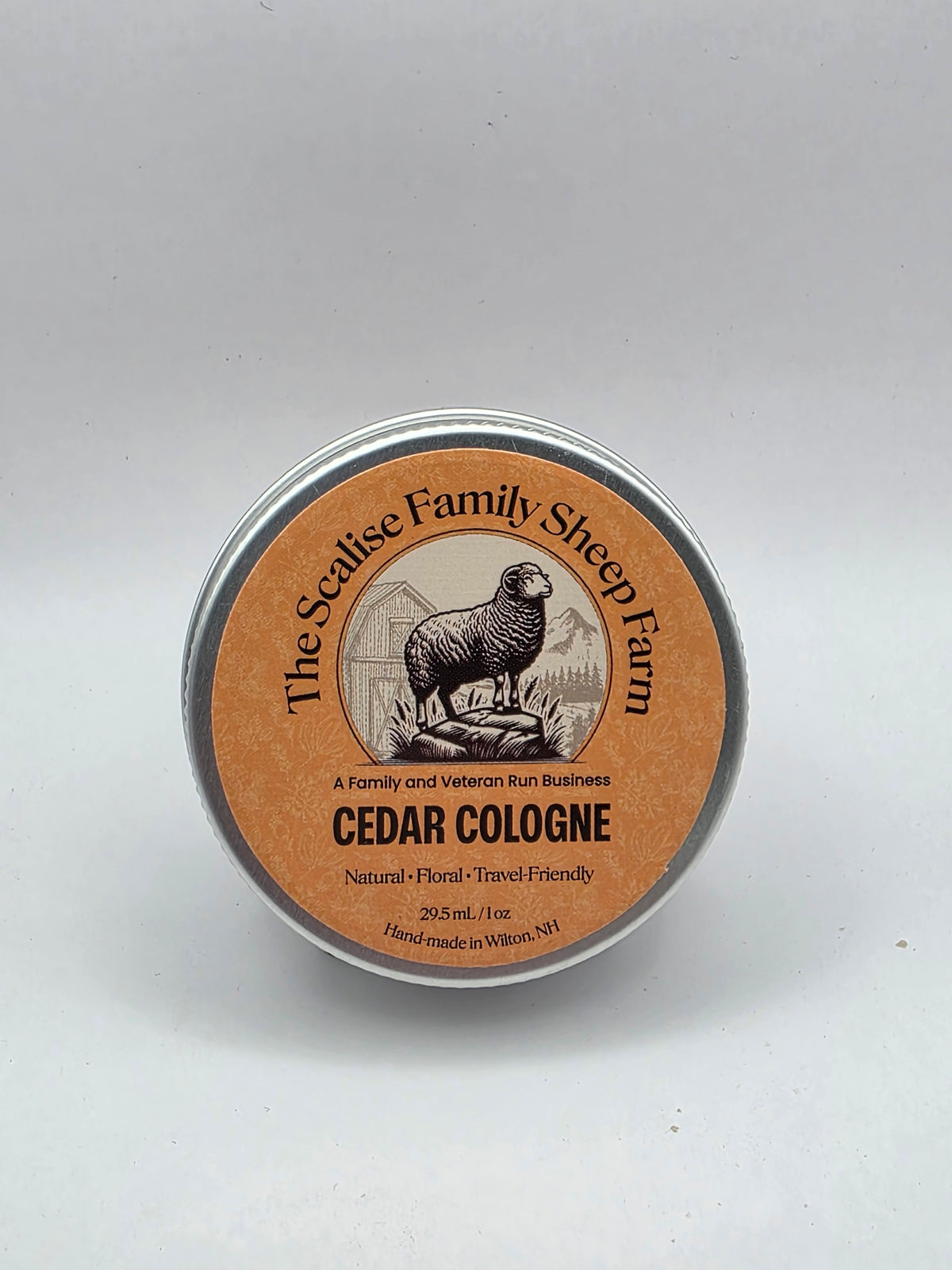
Beards still need regular care and trimming. Balm does not cure a skin condition, and product preferences are personal. The strongest evidence supports gentle grooming, awareness of fragrance and dye exposures, and getting persistent symptoms checked, not loyalty to a particular brand or formula.
Academic References & Scientific Sources
- Tolgyesi E, et al. “A comparative study of beard and scalp hair.” Journal of the Society of Cosmetic Chemists. 1983;34:361–382. Article
- Boothby-Shoemaker W, Comeau N, Daveluy SD. “The dermatologist’s guide to beards: a review of structure, function, care and pathology.” Clinical and Experimental Dermatology. 2023. PubMed
- Maurer M, et al. “The male beard hair and facial skin: challenges for shaving.” PubMed
- Ebling FJ. “The biology of hair.” Dermatologica. 1987. PubMed
- Nagl W. “Different growth rates of pigmented and white hair in the beard: differentiation vs. proliferation?” British Journal of Dermatology. 1995. PubMed
- Gray J, McMichael AJ. “Pseudofolliculitis barbae: understanding the condition and the role of facial grooming.” International Journal of Cosmetic Science. 2016. PubMed
- Polaskey MT, et al. “The Global Prevalence of Seborrheic Dermatitis: A Systematic Review and Meta-Analysis.” JAMA Dermatology. 2024. PubMed
- “Epidemiology and dermatological comorbidity of seborrhoeic dermatitis: population-based study in 161 269 employees.” PubMed
- Sukakul T, et al. “Facial hair shaving behavior and skin problems of shaved areas of males.” PubMed
- Turner GA, et al. “Impact of shaving and anti-perspirant use on the axillary vault.” International Journal of Cosmetic Science. 2008. PubMed
- Hou A, et al. “Facial Dermatitis in Male Patients Referred for Patch Testing: Retrospective Analysis of North American Contact Dermatitis Group Data, 1994 to 2016.” PubMed
- Warshaw EM, et al. “Contact Dermatitis Associated With Hair Care Products: A Retrospective Analysis of the North American Contact Dermatitis Group Data, 2001–2016.” PubMed
- Hsu TS, et al. “Beard dermatitis due to para-phenylenediamine use in Arabic men.” Journal of the American Academy of Dermatology. 2001. PubMed
- Edman B. “The influence of shaving method on perfume allergy.” Contact Dermatitis. PubMed
- “Contact Dermatitis Due to Shaving Creams.” PubMed
- Diepgen TL, et al. “Prevalence of fragrance contact allergy in the general population of five European countries: a cross-sectional study.” British Journal of Dermatology. 2015. DOI
- Pastor-Nieto MA, Gatica-Ortega ME. “Ubiquity, Hazardous Effects, and Risk Assessment of Fragrances in Consumer Products.” Contact Dermatitis. 2021. Full text
- Nong Y, et al. “A review of the use of beeswax in skincare.” Journal of Cosmetic Dermatology. 2023. DOI
- Nyman GSA, et al. “Contact allergy to beeswax and propolis among patients with cheilitis or facial dermatitis.” Contact Dermatitis. 2019. DOI
- Manjaly Thomas ZR, et al. “Contact dermatitis to hair cosmetics: Current diagnostic recommendations.” JDDG: Journal der Deutschen Dermatologischen Gesellschaft. 2021. DOI
- Fluhr JW, et al. “Additive impairment of the barrier function by mechanical irritation, occlusion and sodium lauryl sulphate in vivo.” Contact Dermatitis. 2005. PubMed


