

“Microbiome-friendly” has become a popular skincare phrase: but what does it actually mean when you are choosing a bar of soap?
The short answer is that a microbiome-friendly cleanser should remove dirt, sweat, and excess oil without unnecessarily disturbing the skin barrier, surface pH, or resident microbial community. However, the phrase is not a guarantee that every product labeled “natural,” “handmade,” or “farm-sourced” will have the same effect.
For Scalise Family Sheep Farm, this distinction matters. Our family makes handcrafted sheep-milk soap using milk from our own Icelandic sheep, but we also believe customers deserve a clear explanation of what the science does: and does not: show about natural skincare.
What Is the Skin Microbiome?
The skin microbiome is the community of microorganisms living on and within the skin. It includes bacteria, fungi, viruses, and other microscopic organisms. These microbes are not all harmful. Many are normal residents that coexist with the body and participate in the skin’s ecological balance.
It is helpful to distinguish between:
- Resident microbes: Organisms that regularly live on the skin and are adapted to a particular body site.
- Transient microbes: Organisms temporarily deposited through contact with people, surfaces, clothing, or the environment.
The microbiome varies considerably between dry, oily, and moist areas of the body. It also changes with age, climate, sweat, hormones, hygiene habits, cosmetics, and health conditions.
A healthy skin microbiome is not defined simply by having “more bacteria” or by eliminating every microorganism. Instead, researchers examine factors such as microbial diversity, relative abundance, community composition, and: increasingly: the relationships among organisms in the community.
That is why claims such as “this soap feeds good bacteria” are usually too simplistic. The skin microbiome is an ecosystem, not a simple list of good and bad organisms.
The Skin Barrier and the Acid Mantle
The outermost layer of the skin, the stratum corneum, helps limit water loss and protects against physical, chemical, and microbial stress. Its structure is often compared to bricks and mortar: corneocytes act as the bricks, while lipids: including ceramides, cholesterol, and fatty acids: help form the mortar.
The skin surface is also mildly acidic, often described as the acid mantle. This acidity supports several normal skin processes, including barrier maintenance and microbial balance.
Cleansing can affect both the barrier and pH. The effect depends on the complete formula: not simply whether a product is called natural or synthetic.
A 2022 peer-reviewed review explains that traditional soaps are generally alkaline salts of fatty acids, while syndets are synthetic-detergent cleansers that can be formulated closer to the skin’s natural pH. The authors conclude that traditional soaps are more likely to affect barrier lipids, proteins, and pH, while appropriately formulated syndets can be milder for repeated cleansing.[1]
Traditional Soap Versus Syndet Cleansers
Traditional soap is made through saponification, in which fats or oils react with an alkali to form fatty-acid salts. These cleansing molecules can effectively remove oil and debris, but traditional soap bars are commonly alkaline.
A syndet, short for synthetic detergent, uses surfactants such as anionic, amphoteric, or nonionic cleansing agents. “Synthetic” does not automatically mean harsh, and “natural” does not automatically mean gentle. Mildness depends on the specific surfactants, concentrations, pH, fragrance, preservatives, emollients, and how often the product is used.
Research also shows why it is risky to make sweeping statements about all surfactants. In a three-week facial cleanser study, a formula containing sodium lauroyl sarcosinate was associated with a significant decrease in bacterial alpha diversity, changes in the bacterial community structure, and alterations in measured skin lipids, including ceramides.[2] This does not prove that every product containing that surfactant will behave identically. It does show that cleanser formulation can influence both microbial and lipid profiles.
A more recent study of a high-glycerine cast-melt bar and several body washes found preserved microbiome diversity after regular use. Some products also increased microbial co-occurrence network properties, which the researchers interpreted as a possible indicator of ecosystem resilience.[3] Network changes are an interesting research measure, but they are not the same as proving that a cleanser prevents disease or improves every person’s skin.

Why pH Matters: but Is Not the Whole Story
A cleanser’s pH can influence how it interacts with the stratum corneum. Repeated exposure to alkaline products may raise skin surface pH and affect barrier homeostasis, particularly in people whose skin is already dry or sensitive.
Still, pH should not be considered in isolation. A product’s surfactant system, cleansing strength, contact time, rinse-off behavior, humectants, oils, occlusives, and frequency of use all matter.
In one study, researchers used mild tape stripping to stress the stratum corneum of healthy volunteers. Both an acidic lotion at pH 5.5 and an alkaline lotion at pH 9.3 supported hydration and microbiome recovery compared with no treatment. The acidic lotion produced slightly faster recovery, while the alkaline lotion raised skin surface pH.[4]
This is an important qualification: a well-formulated product may support short-term recovery even when its pH is not acidic. It does not mean that repeated alkaline cleansing is universally harmless.
Similarly, a 28-day randomized evaluation of several specific low-pH leave-on products found no meaningful disruption of microbiome diversity in the study population.[5] The tested products were specific formulas used on forearm skin in post-menopausal women. Their findings should not automatically be applied to every low-pH cleanser, soap bar, or skincare product.
Fragrance, Preservatives, and Glycerin
Fragrance
Fragrance may come from essential oils, fragrance compounds, or a combination of ingredients. A pleasant scent does not indicate that a product is harmful, but fragrance ingredients can cause irritation or allergic contact dermatitis in susceptible individuals.
People with fragrance sensitivity, eczema, or a history of reactions may prefer an unscented option and should patch-test new products. “Natural fragrance” is not synonymous with “non-allergenic.”
Preservatives
Preservatives are especially important in products containing water because they help control unwanted microbial growth inside the product. A preservative system can protect product safety, but some preservative ingredients may irritate or sensitize certain users.
A small randomized, double-blind study compared microbiome-supporting facial products with benchmark products in 14 healthy volunteers over three weeks. The microbiome-supporting regimen improved bacterial diversity and certain cosmetic skin parameters, although the authors noted that larger studies were needed.[6] The study evaluated particular proprietary formulas: not every preservative-free or naturally preserved product.
Glycerin
Glycerin is a humectant, meaning it helps attract and hold water. Its presence may contribute to a more comfortable cleansing experience, but glycerin alone does not make a product microbiome-friendly. The entire formula still determines how the product interacts with skin.
What About Prebiotics, Postbiotics, and Probiotics?
These terms are related but should not be used interchangeably:
- Probiotics generally refer to live microorganisms.
- Prebiotics are substrates intended to be selectively used by microorganisms.
- Postbiotics are preparations of inanimate microorganisms or their components that may provide a benefit.
A six-week multi-omic study evaluated a body wash and lotion containing prebiotic and postbiotic ingredients versus comparable control products in people with dry skin. Both groups improved skin hydration, while the prebiotic/postbiotic group showed additional changes in microbial composition, microbial pathways, and skin metabolites.[7] The study was funded by Colgate-Palmolive, with company involvement in study design and analysis, so the results are useful but should be interpreted with appropriate attention to sponsorship and formula specificity.
A soap should not be called probiotic, prebiotic, or postbiotic simply because it is natural or contains milk, oils, herbs, or botanical ingredients. Those claims require a formula-specific rationale and supporting evidence.
Where Does Sheep-Milk Soap Fit?
Sheep-milk soap is a traditional soap category, not automatically a syndet or a clinically proven microbiome-supporting product. There is currently no direct clinical evidence showing that sheep-milk soap is universally superior for the skin microbiome.
The potential benefits for skin depend on the complete formula, including:
- The oils, fats, and milk used
- The final pH
- Superfatting and soap-making method
- Fragrance or essential-oil level
- Any botanical additives
- How frequently the bar is used
- Whether the user’s skin is dry, oily, sensitive, or inflamed
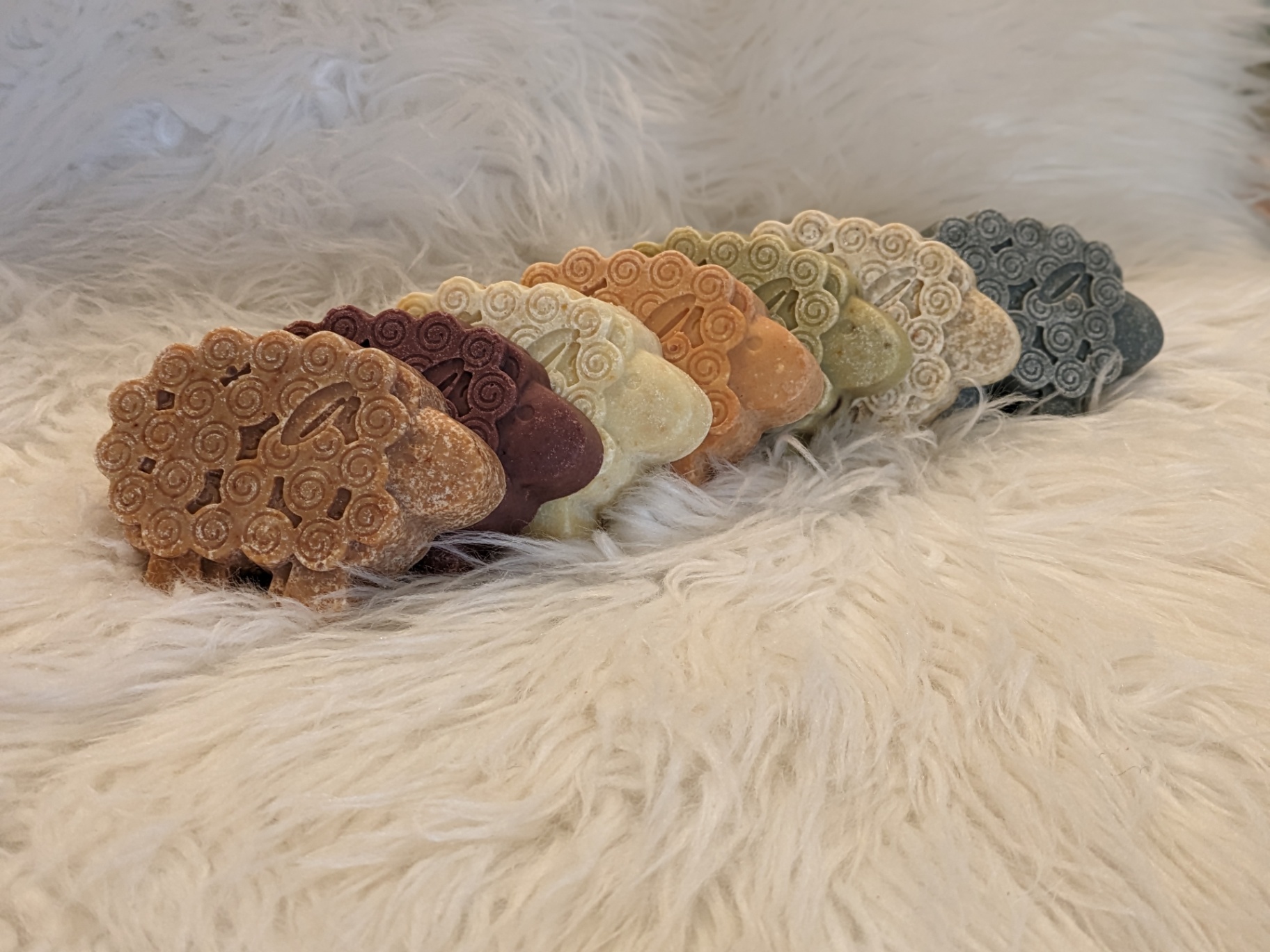
At Scalise Family Sheep Farm, our sheep-milk soap is handmade in small batches using sheep’s milk from our own farm. We value natural ingredients and ingredient transparency, but we do not want to imply that “natural” alone proves microbiome superiority.
A Cautious Routine for Sensitive Skin
If you have sensitive skin or eczema-prone skin, consider:
- Use lukewarm rather than hot water.
- Cleanse only areas that need cleansing rather than repeatedly washing already-dry skin.
- Avoid scrubbing or using abrasive exfoliants on irritated areas.
- Consider fragrance-free products during periods of sensitivity.
- Rinse thoroughly and pat dry.
- Apply a fragrance-free moisturizer while the skin is still slightly damp.
- Stop using a product if burning, swelling, persistent itching, or worsening redness occurs.
People with eczema or recurring dermatitis should discuss persistent symptoms with a qualified healthcare professional. Soap and skincare products are not treatments for eczema, infection, acne, or other medical conditions.
The Practical Definition of “Microbiome-Friendly”
A responsible definition is:
A microbiome-friendly cleanser is a specific formula designed and tested to cleanse effectively while minimizing unnecessary disruption to the skin barrier, pH, and microbial community.
The strongest evidence supports evaluating the whole product: not relying on one marketing word or one ingredient. For any sheep-milk soap, handmade natural soap, or farm-sourced skincare product, consider the complete formula, fragrance level, pH, frequency of use, and your individual response.
That balanced approach allows customers to appreciate the craftsmanship and benefits for skin that a small-batch soap may offer without making claims the current evidence cannot support.
Academic References & Scientific Sources
-
Gholizadeh S, et al. “Skin Cleansing without or with Compromise: Soaps and Syndets.” Molecules. 2022. PMID: 35335373. Full text.
-
Zhao H, et al. “The impacts of sodium lauroyl sarcosinate in facial cleanser on facial skin microbiome and lipidome.” Journal of Cosmetic Dermatology. 2024. PMID: 37990616. DOI: 10.1111/jocd.16092.
-
“Mild cleansers and the skin microbiome: effects on diversity and co-occurrence networks.” British Journal of Dermatology. 2025. PMID: 41118317. DOI: 10.1093/bjd/ljaf282.
-
Uhr D, et al. “Acidic Skin Care and the Cutaneous Microbiome After Stratum Corneum Stress.” Dermatology. 2022. PMID: 35908536. DOI: 10.1159/000526228.
-
Janssens-Böcker C, et al. “Influence of Cosmetic Skincare Products with pH < 5 on the Skin Microbiome: A Randomized Clinical Evaluation.” Dermatology and Therapy. 2025. PMID: 39709312. DOI: 10.1007/s13555-024-01321-x.
-
Santamaria E, et al. “Randomized comparative double-blind study assessing microbiome-supporting skincare versus conventional skincare.” International Journal of Cosmetic Science. 2023;45(1):83–94. PMID: 36367009. DOI: 10.1111/ics.12826.
-
Li M, et al. “Multi-omic approach to decipher the impact of skincare products with pre/postbiotics on skin microbiome and metabolome.” Frontiers in Medicine. 2023;10:1165980. PMID: 37534320. DOI: 10.3389/fmed.2023.1165980.


