

If your skin feels coated, tight, or irritated after washing: or your soap seems difficult to rinse away: hard water may be part of the explanation.
Hard water contains dissolved minerals, primarily calcium and magnesium ions. These minerals are not usually a health hazard in household water, but they can change how cleansers behave. The result may be less lather, more residue, and the familiar film called soap scum.
The important distinction is formulation. Traditional soap and synthetic detergent bars do not respond to hard water in exactly the same way.
What happens when hard water meets traditional soap?
Traditional soap is made from fatty acids chemically combined with an alkali, creating fatty acid salts. In a bar of handmade natural soap, those salts may include sodium or potassium salts of fatty acids.
When the soap mixes with hard water, calcium and magnesium ions can replace the sodium or potassium. The reaction produces insoluble calcium and magnesium fatty acid salts:
Fatty acid soap + calcium or magnesium ions → insoluble calcium or magnesium fatty acid salts
These insoluble compounds are commonly called soap scum or lime soap. They can settle on shower walls, laundry, hair, and skin.
That chemistry explains why hard water and soap can leave a feeling of “soap that won’t rinse off.” The residue may feel tacky, waxy, or slightly gritty. It can also reduce lather because some of the soap is being converted into an insoluble deposit instead of remaining available to form bubbles.
This is a genuine formulation difference: not simply a marketing claim.
Synthetic detergent bars, often called syndets, use detergent surfactants rather than traditional fatty acid soap. Many syndet formulations are also designed at a lower pH and may include chelating ingredients that bind calcium and magnesium. As a result, they are generally less affected by hard water than traditional soap bars.
That does not mean every syndet is automatically gentle, or that every traditional soap will irritate everyone. The cleanser, ingredients, water hardness, temperature, washing time, and condition of the person’s skin all matter.

Can hard water cause skin irritation?
The honest answer is: hard water can contribute to irritation in some circumstances, but it is not the only factor and it does not automatically cause skin disease.
A key study by Danby and colleagues examined how water hardness affected surfactant deposition after washing. Researchers studied healthy participants and people with atopic dermatitis, including participants with and without filaggrin gene mutations. Skin sites were washed with sodium lauryl sulfate, a model surfactant, in water with different hardness levels.
Hard-water sites had significantly greater surfactant deposits. Those deposits were associated with increased transepidermal water loss and irritation, particularly among participants with atopic dermatitis and filaggrin mutations.1
This finding is important, but it should not be overstated. The study used a controlled surfactant exposure rather than testing every soap or cleanser on the market. The effect depends on the surfactant, the formulation, the amount used, and how thoroughly the skin is rinsed: not on water hardness alone.
A prior controlled study also found that hard-water rinsing could affect dryness, redness, hydration, and soap binding to skin, although the relationship changed under different washing conditions.2 In practical terms, hard water may make a cleanser more difficult to remove, but product choice and washing habits still matter greatly.
What does the eczema research show?
Studies across regions have reported associations between harder domestic water and eczema prevalence. For example, research in infants and children has linked higher calcium carbonate concentrations in household water with a greater likelihood of atopic dermatitis.3
A large UK Biobank cohort study involving more than 300,000 adults found that water hardness was associated with prevalent eczema. Water containing more than 200 mg/L of calcium carbonate was associated with higher odds of eczema at baseline. However, the study did not find an association with newly developed eczema during follow-up.4
These findings are useful, but they are observational. People living in different regions also differ in climate, housing, income, occupation, bathing habits, product use, pollution exposure, and access to medical care. An ecological or regional association cannot prove that hard water caused an individual person’s eczema.
A systematic review and meta-analysis found increased odds of atopic eczema among children exposed to harder water, but rated the certainty of the observational evidence as very low. It also found no significant improvement in objective eczema severity from household water softeners.5
The important negative trial: SWET
The Softened Water Eczema Trial was a multicenter randomized controlled trial involving 336 children with moderate-to-severe eczema who lived in hard-water areas. Families were assigned either an ion-exchange water softener plus usual eczema care or usual care alone.
After 12 weeks, eczema severity improved in both groups, but there was no statistically significant difference between them. The researchers concluded that water softeners provided no additional benefit over usual care.6
This result deserves emphasis:
A water softener is not a treatment for eczema.
The SWET trial does not disprove the possibility that hard water contributes to skin-barrier stress, especially early in life or in people with genetically vulnerable skin. It does show that installing a softener is not a reliable stand-alone treatment for established eczema.
What can you change?
The most useful response is usually to reduce cleanser residue and protect the skin barrier.
1. Use less soap
More soap does not necessarily mean cleaner skin. In hard water, excess traditional soap can create more insoluble residue. Use enough to clean the areas that need it, rather than covering the entire body with a heavy layer of lather.
2. Rinse with more water
A thorough rinse can make a noticeable difference. Pay attention to skin folds, hands, feet, and areas where the water feels less effective. If your skin feels coated after bathing, the problem may be incomplete removal rather than a lack of cleansing.
3. Keep water lukewarm
Hot water can increase dryness and worsen the feeling of tightness. Lukewarm water is generally a better choice, especially for dry or sensitive skin.
4. Choose the right cleanser
If traditional soap consistently leaves a film or worsens irritation, consider a low-irritant syndet bar or cleanser formulated for hard-water conditions. If you prefer handmade natural soap, use less product, rinse carefully, and observe how your skin responds.
5. Moisturize while skin is still damp
After gently patting dry, apply a moisturizer or balm while the skin still holds some water. An occlusive balm can help slow moisture loss from the outer skin layer.
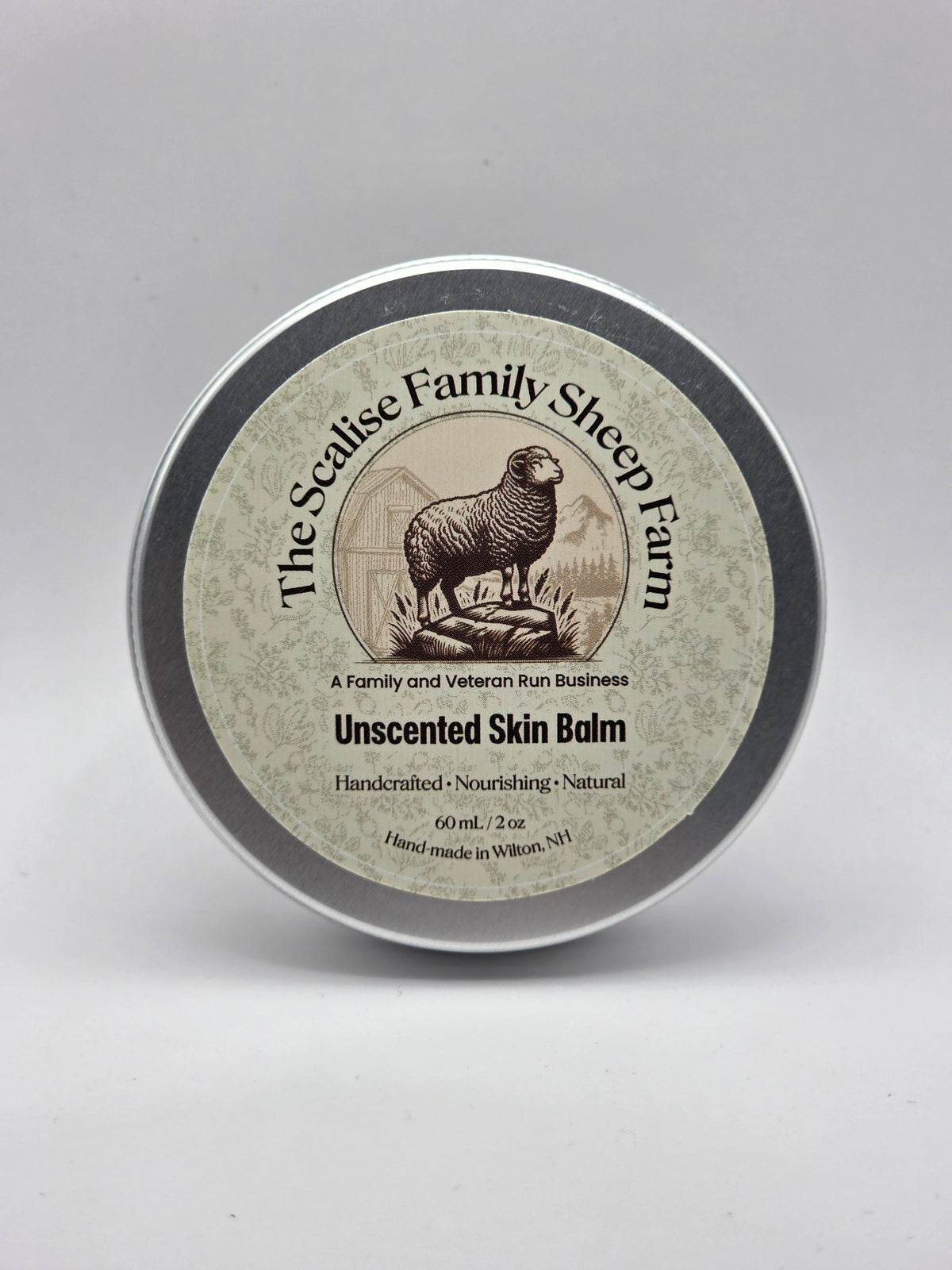
Our Unscented Skin Balm is fragrance-free and made in small batches with farm-sourced lanolin, olive oil, mango butter, shea butter, and beeswax. It is intended to provide a protective, moisturizing layer for dry areas such as hands, elbows, and patches of rough skin.
6. Consider an occasional mineral-removing product
If mineral buildup is the main problem, an acidic rinse or chelating product designed for the intended use may help remove deposits. Follow the product directions, avoid applying strong acids to irritated or broken skin, and patch-test new products.
A shower filter may reduce some contaminants, but many basic filters do not remove calcium and magnesium. A true ion-exchange water softener is more relevant to hardness, but the SWET results mean expectations should remain realistic.
Where sheep-milk soap fits
At Scalise Family Sheep Farm, our sheep-milk soap is a traditional cold-process-style bar made in small batches with milk from our own Icelandic sheep. We use natural ingredients and do not claim that our soap solves hard-water problems.
In fact, we want to be plain about the tradeoff: in very hard water, a traditional sheep-milk soap may produce more soap scum than a syndet bar.
Our Lavender Sheep Milk Soap and Frankincense Sheep Milk Soap are made for people who value handcrafted, farm-sourced products and the sensory experience of a traditional bar. The benefits for skin depend on the individual, the formulation, and how the product is used: not simply on the fact that it is natural.

For hard-water households, try using a smaller amount, keep the bar dry between uses, rinse your skin thoroughly, and apply a balm afterward. If you continue to experience tightness, itching, or residue, a syndet cleanser may be a better fit for your routine.
What about acne and hair?
Claims connecting hard water with acne or hair damage are common, but the scientific evidence is much weaker than the evidence involving soap residue, surfactant deposition, and eczema-related skin-barrier concerns.
Hard water can leave mineral deposits on hair and may make hair feel coated or less manageable. That is a cosmetic and formulation issue, not proof that hard water is damaging every person’s hair or causing acne.
Hard-water minerals also should not be viewed as a skincare treatment. They remain primarily in the water and on the surface of materials; there is no good basis for expecting calcium or magnesium in hard water to nourish the skin through routine washing.
The bottom line
Hard water changes the chemistry of traditional soap. Calcium and magnesium can react with fatty acid soap to create insoluble deposits that reduce lather and leave residue on skin and fabric.
Hard water may contribute to irritation by increasing cleanser deposition, especially in people with a compromised skin barrier. However, regional studies do not prove causation, and the SWET randomized trial found that water softeners did not significantly improve established childhood eczema.
Start with the changes you can control: use less cleanser, rinse thoroughly, keep water lukewarm, choose a suitable formulation, and moisturize while skin is damp. If dermatitis persists, spreads, becomes painful, or repeatedly flares, consult a dermatologist rather than relying on a soap, filter, or water softener alone.
Medical disclaimer: This article is for general educational purposes and is not medical advice. Skincare products can cause irritation or allergic reactions, including products made with natural ingredients. Stop using any product that causes discomfort and seek medical advice for persistent, severe, infected, or unexplained dermatitis.
Academic References & Scientific Sources
-
Danby SG, Brown K, Wigley AM, et al. “The Effect of Water Hardness on Surfactant Deposition after Washing and Subsequent Skin Irritation in Atopic Dermatitis Patients and Healthy Control Subjects.” Journal of Investigative Dermatology. 2018;138(1):68–77. PMID 28927888 · DOI: 10.1016/j.jid.2017.08.037
-
“The Influence of Hard Water (Calcium) and Surfactants on the Skin.” Contact Dermatitis. 1996;35(6):337–343. PMID 9118628 · DOI: 10.1111/j.1600-0536.1996.tb02414.x
-
Perkin MR, Craven J, Logan K, et al. “Association Between Domestic Water Hardness, Chlorine, and Atopic Dermatitis Risk in Early Life: A Population-Based Cross-Sectional Study.” Journal of Allergy and Clinical Immunology. 2016;138(2):509–516. PMID 27241890 · DOI: 10.1016/j.jaci.2016.03.031
-
Lopez DJ, Singh A, Waidyatillake NT, et al. “The Association Between Domestic Hard Water and Eczema in Adults from the UK Biobank Cohort Study.” British Journal of Dermatology. 2022;187(5):704–712. PMID 35822417 · DOI: 10.1111/bjd.21771
-
Jabbar-Lopez ZK, Ung CY, Alexander H, et al. “The Effect of Water Hardness on Atopic Eczema, Skin Barrier Function: A Systematic Review and Meta-Analysis.” Clinical & Experimental Allergy. 2021;51(3):430–451. PMID 33259122 · DOI: 10.1111/cea.13797
-
Thomas KS, Dean T, O’Leary C, et al. “A Randomised Controlled Trial of Ion-Exchange Water Softeners for the Treatment of Eczema in Children.” PLoS Medicine. 2011;8(2):e1000395. PMID 21358807 · DOI: 10.1371/journal.pmed.1000395
-
Jabbar-Lopez ZK, Craven J, Logan K, et al. “Longitudinal Analysis of the Effect of Water Hardness on Atopic Eczema: Evidence for Gene–Environment Interaction.” British Journal of Dermatology. 2020;183(2):285–293. PMID 31599965 · DOI: 10.1111/bjd.18597


