

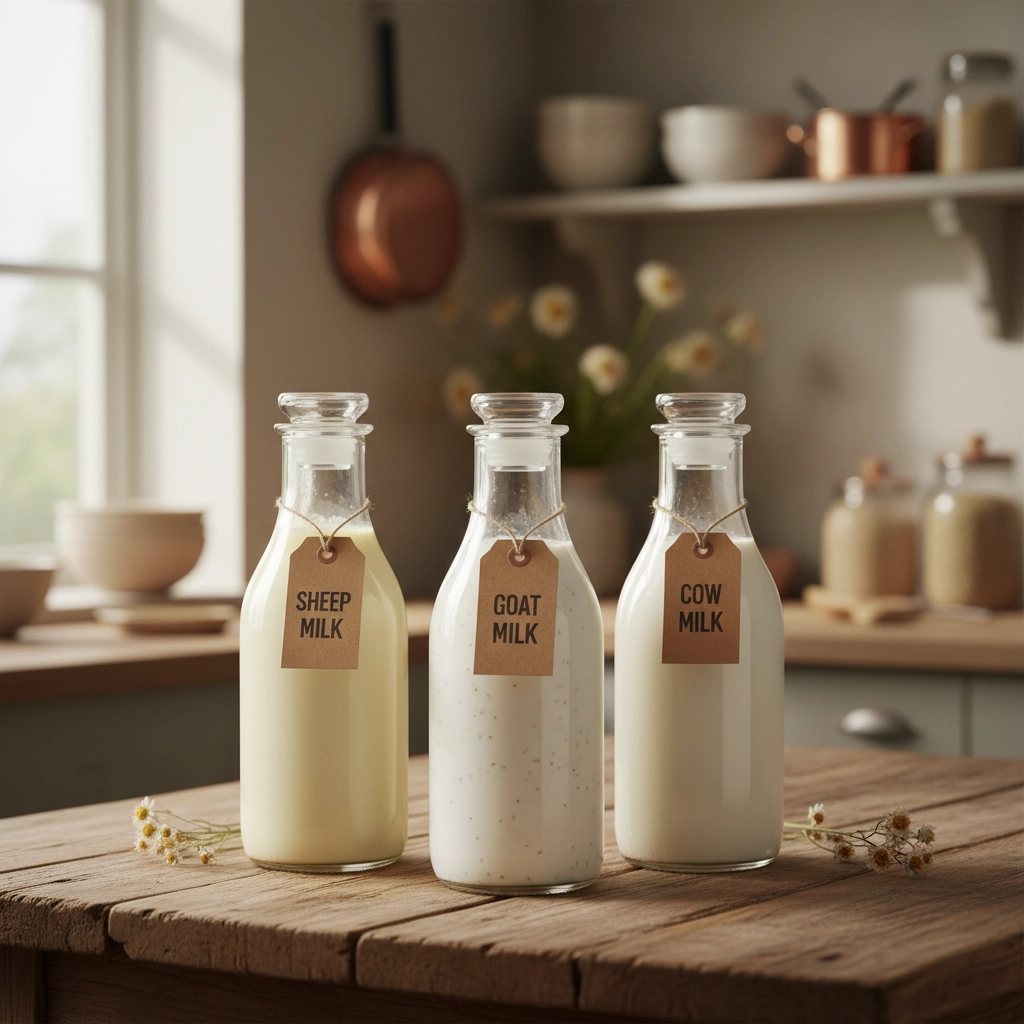
When it comes to natural skincare, not all milk is created equal. If you've been wondering whether sheep milk, goat milk, or cow milk is best for your skin, you're asking the right questions. As a family farm that's been working with sheep milk for years, we've seen firsthand how different types of milk can transform your skincare routine.
The truth is, while cow milk dominates grocery store shelves, it's actually the least beneficial option for your skin. Sheep milk and goat milk both offer superior benefits, but each shines in different ways. Let's break down what makes each type unique and help you choose the best option for your specific skin needs.
The Sheep Milk Advantage: Nature's Most Nutrient-Dense Option
Sheep milk is the heavyweight champion when it comes to skincare nutrition. Here at our farm, we've seen how our Icelandic sheep produce milk that's incredibly rich in skin-loving nutrients. The numbers tell the story: sheep milk contains double the amount of fat compared to both cow and goat milk, with a fat content of 6% or more. [1,2]
This high fat concentration isn't just impressive on paper, it translates into exceptional moisturizing power. When you use sheep milk soap or skincare products, you're getting deep, long-lasting hydration that penetrates beyond the surface layer of your skin.
But the benefits go way beyond just fat content. Sheep milk contains twice the nutrient concentration found in goat milk, including double the protein content and significantly higher levels of vitamins A, B, and E. [1,2] These vitamins are crucial for maintaining healthy, youthful-looking skin. Vitamin A promotes cell turnover and repair, while vitamin E acts as a powerful antioxidant protecting against environmental damage.
The mineral profile is equally impressive, with elevated levels of calcium, phosphorus, potassium, and magnesium. [2,4] These minerals support skin barrier function and help maintain proper moisture balance.
What makes sheep milk especially gentle is its higher lactose content and lower acidity compared to goat milk. [1,3] This creates a soap that's less irritating and perfect for people with sensitive skin conditions like eczema or dermatitis. The medium-chain triglycerides in sheep milk also provide additional nourishment while being easily absorbed by the skin. [2]
Goat Milk: The pH-Perfect Choice
Goat milk has earned its reputation as a skincare superstar, and for good reason. Its naturally low pH level closely matches human skin's natural balance, typically ranging between 6.1 and 6.4. [3] This pH compatibility is crucial because it helps maintain your skin's protective acid mantle without causing irritation or dryness.
One of goat milk's standout features is its lactic acid content, which acts as a natural exfoliant. [6,7] Unlike harsh chemical exfoliants, lactic acid gently removes dead skin cells, revealing brighter, smoother skin underneath. This makes goat milk particularly effective for people dealing with dull or rough skin texture.
The vitamin content in goat milk is impressive too, with high levels of vitamins A, D, and B6, plus selenium. [5,8] Vitamin A is essential for skin cell regeneration and can help reduce the appearance of fine lines and age spots. Selenium acts as an antioxidant, protecting your skin from free radical damage.
What really sets goat milk apart are its bioactive components, including lactoferrin and lysozyme. These naturally occurring compounds have antimicrobial, anti-inflammatory, and immune-supporting properties. Research shows these components can be particularly helpful for managing chronic skin conditions like eczema and psoriasis by reducing inflammation and supporting the skin's natural healing processes. [9,10,11]
The fat content in goat milk is lower than sheep milk (typically less than 4%), but it's still sufficient to provide good moisturizing benefits without feeling heavy or greasy on the skin. [1]
Cow Milk: The Least Favorable Option
While cow milk might be what most people think of first, it's actually the least beneficial option for skincare purposes. Cow milk contains significantly lower fat content compared to sheep milk, which means less moisturizing power for your skin. [1,2]
More concerning is cow milk's higher casein protein content, which can be more difficult for some people's skin to tolerate. Some studies suggest that dairy products, particularly cow milk, may contribute to skin issues like acne in certain individuals. [12-14] The inflammatory potential of cow milk proteins, combined with its lower concentration of skin-beneficial nutrients, makes it the least optimal choice among the three.
The pH level of cow milk is also less compatible with human skin compared to goat milk, potentially disrupting your skin's natural balance over time.
Head-to-Head Comparison
| Attribute | Sheep Milk | Goat Milk | Cow Milk |
|---|---|---|---|
| Fat Content | 6%+ (highest) | <4% | Lower than sheep |
| Moisturizing Power | Excellent | Good | Moderate |
| pH Level | Less acidic, gentle | Matches skin pH | Less compatible |
| Vitamin A | Very High | High | Moderate |
| Protein Content | Double that of goat | Good | Moderate |
| Anti-inflammatory | Yes | Excellent | Limited |
| Sensitive Skin | Excellent | Excellent | Poor |
| Natural Exfoliation | Mild | Good (lactic acid) | Limited |
| Acne-prone Skin | Good | Excellent | May worsen |
Choosing the Right Milk for Your Skin Type
For Dry or Very Dry Skin: Sheep milk is your best friend. The exceptionally high fat content and concentrated nutrients provide the deep, intensive hydration that dry skin craves. Our sheep milk soaps are specifically formulated to deliver this rich moisture.
For Sensitive Skin: Both sheep and goat milk are excellent choices, but for different reasons. Sheep milk offers gentleness through its lower acidity and rich, soothing properties. It's particularly good if your sensitive skin is also dry.
For Acne-prone Skin: Goat milk takes the lead here. The natural exfoliating properties from lactic acid help unclog pores, while the anti-inflammatory compounds calm irritated skin. [6,9,12] The pH balance also helps maintain healthy skin bacteria.
For Eczema and Psoriasis: This is where goat milk really shines due to its proven anti-inflammatory and antimicrobial properties. However, sheep milk's ultra-gentle, deeply moisturizing nature can also provide significant relief for these conditions. [9,10,11]
For Anti-aging Goals: Goat milk edges ahead with its vitamin A content for cell renewal and lactic acid for gentle resurfacing. However, sheep milk provides the intensive nourishment that mature skin needs to maintain elasticity and hydration. [6,7]
For Normal Skin: Either sheep or goat milk will enhance your skincare routine. Choose sheep milk if you want maximum nourishment and hydration, or goat milk if you prefer gentle exfoliation and pH balance.
Making the Switch to Natural Milk Skincare
Whether you choose sheep milk or goat milk products, you're making a significant upgrade from conventional skincare. The key is consistency: natural milk-based products work gently over time to improve your skin's health and appearance.
At our family farm, we've seen countless customers transform their skin by switching to our handcrafted sheep milk soaps and complementary products like our nourishing skin balms. The combination of pure, nutrient-rich sheep milk with carefully selected natural ingredients creates skincare that's both effective and gentle.
The bottom line? Skip the cow milk for skincare purposes. Both sheep and goat milk offer superior benefits, with sheep milk excelling in deep moisturization and goat milk leading in versatility for various skin concerns. Your skin will thank you for making the switch to these naturally nourishing alternatives.
References
- Hadjipanayiotou M. Composition of ewe, goat and cow milk and of colostrum of ewes and goats. Small Ruminant Research (1995). https://www.sciencedirect.com/science/article/pii/0921448895006973
- Moatsou G, Sakkas L. Sheep milk components: Focus on nutritional advantages and biofunctional potential. Small Ruminant Research (2019). https://www.sciencedirect.com/science/article/pii/S0921448819301294
- Park YW, Juárez M, Ramos M, Haenlein GFW. Physico-chemical characteristics of goat and sheep milk. Small Ruminant Research (2007). https://www.sciencedirect.com/science/article/abs/pii/S0921448806002549
- Mayer HK, Fiechter G. Physical and chemical characteristics of sheep and goat milk in Austria. International Dairy Journal (2012). https://www.sciencedirect.com/science/article/pii/S0958694611002573
- Stergiadis S, Nørskov NP, Purup S, Givens I, Lee MRF. Comparative Nutrient Profiling of Retail Goat and Cow Milk. Nutrients (2019). https://www.ncbi.nlm.nih.gov/pmc/articles/PMC6835441/
- Applications of hydroxy acids: classification, mechanisms, and photoactivity. (2010). https://www.ncbi.nlm.nih.gov/pmc/articles/PMC3047947/
- Mizukoshi K, et al. Effects of lactic acid on the flexibility of the stratum corneum. Skin Research and Technology (2020). https://onlinelibrary.wiley.com/doi/10.1111/srt.12841
- Nayik GA, Jagdale YD, Gaikwad SA, Devkatte AN, Dar AH, et al. Recent Insights Into Processing Approaches and Potential Health Benefits of Goat Milk and Its Products: A Review. Frontiers in Nutrition (2021). https://pmc.ncbi.nlm.nih.gov/articles/PMC8685332/
- Recio I, Visser S. Antibacterial and binding characteristics of bovine, ovine and caprine lactoferrins: a comparative study. International Dairy Journal (2000). https://www.sciencedirect.com/science/article/pii/S0958694600000893
- Seifu E, Buys EM, Donkin EF, Petzer I-M. Antibacterial activity of the lactoperoxidase system against food-borne pathogens in Saanen and South African Indigenous goat milk. Food Control (2004). https://www.sciencedirect.com/science/article/pii/S0956713503001208
- ALKaisy QH, Al‑Saadi JS, AL‑Rikabi AKJ, Altemimi AB, Hesarinejad MA, Abedelmaksoud TG. Exploring the health benefits and functional properties of goat milk proteins. Food Science & Nutrition (2023). https://pmc.ncbi.nlm.nih.gov/articles/PMC10563692/
- Juhl CR, et al. Dairy Intake and Acne Vulgaris: A Systematic Review and Meta-Analysis of 78,529 Children, Adolescents, and Young Adults. Nutrients (2018). https://pmc.ncbi.nlm.nih.gov/articles/PMC6115795/
- Dai R, et al. The effect of milk consumption on acne: a meta-analysis of observational studies. Journal of the European Academy of Dermatology and Venereology (2018). https://pubmed.ncbi.nlm.nih.gov/30079512/
- Aghasi M, et al. Dairy intake and acne development: A meta-analysis of observational studies. Clinical Nutrition (2019). https://www.sciencedirect.com/science/article/abs/pii/S0261561418301663


